Blood sugar charts by age, risk, and test type


Key takeaways:
Blood sugar levels fluctuate throughout the day and are influenced by factors such as diet, stress, medication, and exercise. Monitoring trends is more important than focusing on singular numbers.
People with diabetes must monitor their blood sugar levels regularly, follow a treatment plan that may include dietary changes, exercise, medication, and insulin, and understand their target blood sugar ranges.
Continuous glucose monitoring (CGM) systems offer real-time insights into blood sugar.
Blood sugar, also known as blood glucose, is the main sugar in your blood. It comes from foods you eat, and the blood carries glucose to your body's cells, where it is used for energy.
People with diabetes have higher than normal blood glucose levels, or hyperglycemia. Over time, high blood sugar can cause complications like heart disease, stroke, and heart attack. It can also cause kidney disease, eye problems, nerve damage, and other health problems.
If you have diabetes, your healthcare provider will give you more information about keeping your blood sugar numbers in a target range. They will also tell you how often and when to check your blood sugar and what to do if your blood sugar is high or low. You may need to make dietary changes and increase your physical activity. You may also need to take medication or insulin.
Blood sugar level charts
Blood sugar levels naturally fluctuate throughout the day due to factors such as food intake, stress, medication, exercise, and more.
“Glucose management will always be a journey, never a destination,” says Stephen Ponder, MD, a pediatric endocrinologist at McLane Children’s Hospital in Temple, Texas, and author of the popular book Sugar Surfing. Dr. Ponder recommends that patients consider blood sugar levels as continuous trending patterns rather than singular numbers. He explains that blood sugar is a dynamic variable that shifts over time and that it is easier to manage blood sugar once a blood sugar trend pattern is recognized.
Monitoring your blood sugar can give you great insight into how it fluctuates throughout the day and in response to food, exercise, and other factors.
The charts below provide general numbers and ranges. Your healthcare provider will give you a target range, which may be slightly different than the numbers in the charts below. As Dr. Ponder notes, diagnostic standards and ranges are based on venipuncture blood samples, not a blood glucose meter or sensors.
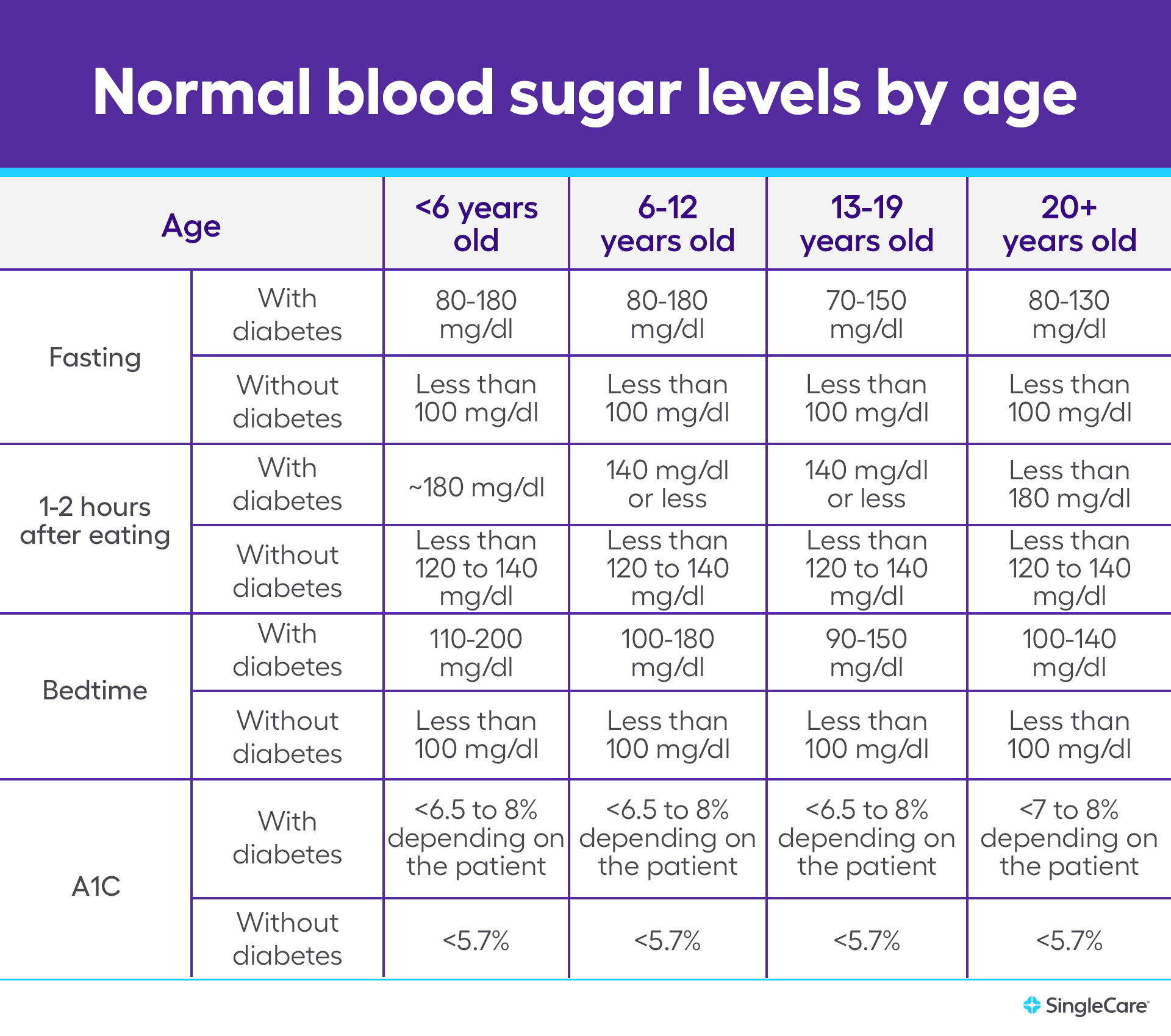
Normal blood sugar levels by age |
|||||
|---|---|---|---|---|---|
| Age | Younger than 6 years old | 6-12 years old | 13-19 years old | 20 years and older | |
| Fasting | With diabetes | 80-180 mg/dl mg/dl (milligrams per deciliter) | 80-180 mg/dl | 70-150 mg/dl | 80-130 mg/dl |
| Without diabetes | Less than 100 mg/dl | Less than 100 mg/dl | Less than 100 mg/dl | Less than 100 mg/dl | |
| 1-2 hours after eating | With diabetes | ~180 mg/dl | 140 mg/dl or less | 140 mg/dl or less | Less than 180 mg/dl |
| Without diabetes | Less than 120 to 140 mg/dl | Less than 120 to 140 mg/dl | Less than 120 to 140 mg/dl | Less than 120 to 140 mg/dl | |
| Bedtime | With diabetes | 110-200 mg/dl | 100-180 mg/dl | 90-150 mg/dl | 100-140 mg/dl |
| Without diabetes | Less than 100 mg/dl | Less than 100 mg/dl | Less than 100 mg/dl | Less than 100 mg/dl | |
| A1C | With diabetes | <6.5 to 8% depending on the patient | <6.5 to 8% depending on the patient | <6.5 to 8% depending on the patient | <7 to 8% depending on the patient |
| Without diabetes | <5.7% | <5.7% | <5.7% | <5.7% | |
Download this normal blood sugar levels chart by age here.
RELATED: Learn more about normal blood sugar levels
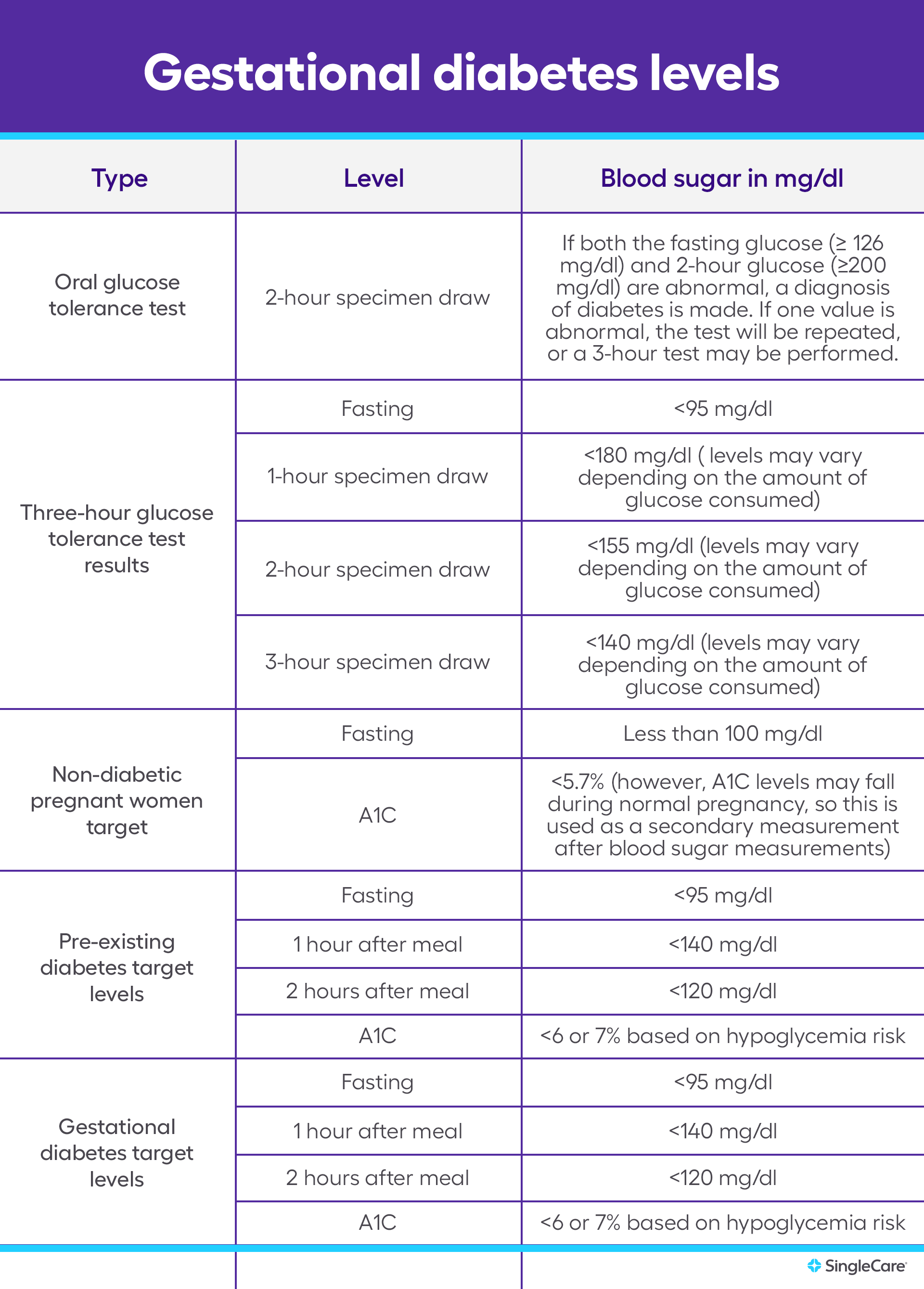
Normal blood sugar levels during pregnancy |
||
|---|---|---|
| Type | Level | Blood sugar in mg/dl |
| Oral glucose tolerance test results | 2-hour specimen draw | If both the fasting blood glucose (≥ 126 mg/dl) and 2-hour glucose (≥200 mg/dl) are abnormal, a diagnosis of diabetes is typically made. If one value is abnormal, the test will be repeated, or a 3-hour test may be performed. |
| Three-hour glucose tolerance test results | Fasting | <95 mg/dl |
| 1-hour specimen draw | <180 mg/dl ( levels may vary depending on the amount of glucose consumed) | |
| 2-hour specimen draw | <155 mg/dl (levels may vary depending on the amount of glucose consumed) | |
| 3-hour specimen draw | <140 mg/dl (levels may vary depending on the amount of glucose consumed) | |
| Non-diabetic pregnant women target | Fasting | Less than 100 mg/dl |
| A1C | <5.7% (however, A1C levels may fall during normal pregnancy, so this is used as a secondary measurement after blood sugar measurements) | |
| Pre-existing diabetes target levels | Fasting | <95 mg/dl |
| 1 hour after meal | <140 mg/dl | |
| 2 hours after meal | <120 mg/dl | |
| A1C | <6 or 7% based on hypoglycemia risk | |
| Gestational diabetes target levels | Fasting | <95 mg/dl |
| 1 hour after meal | <140 mg/dl | |
| 2 hours after meal | <120 mg/dl | |
| A1C | <6 or 7% based on hypoglycemia risk |
Download this normal blood sugar levels during pregnancy chart here.
RELATED: Learn more about gestational diabetes
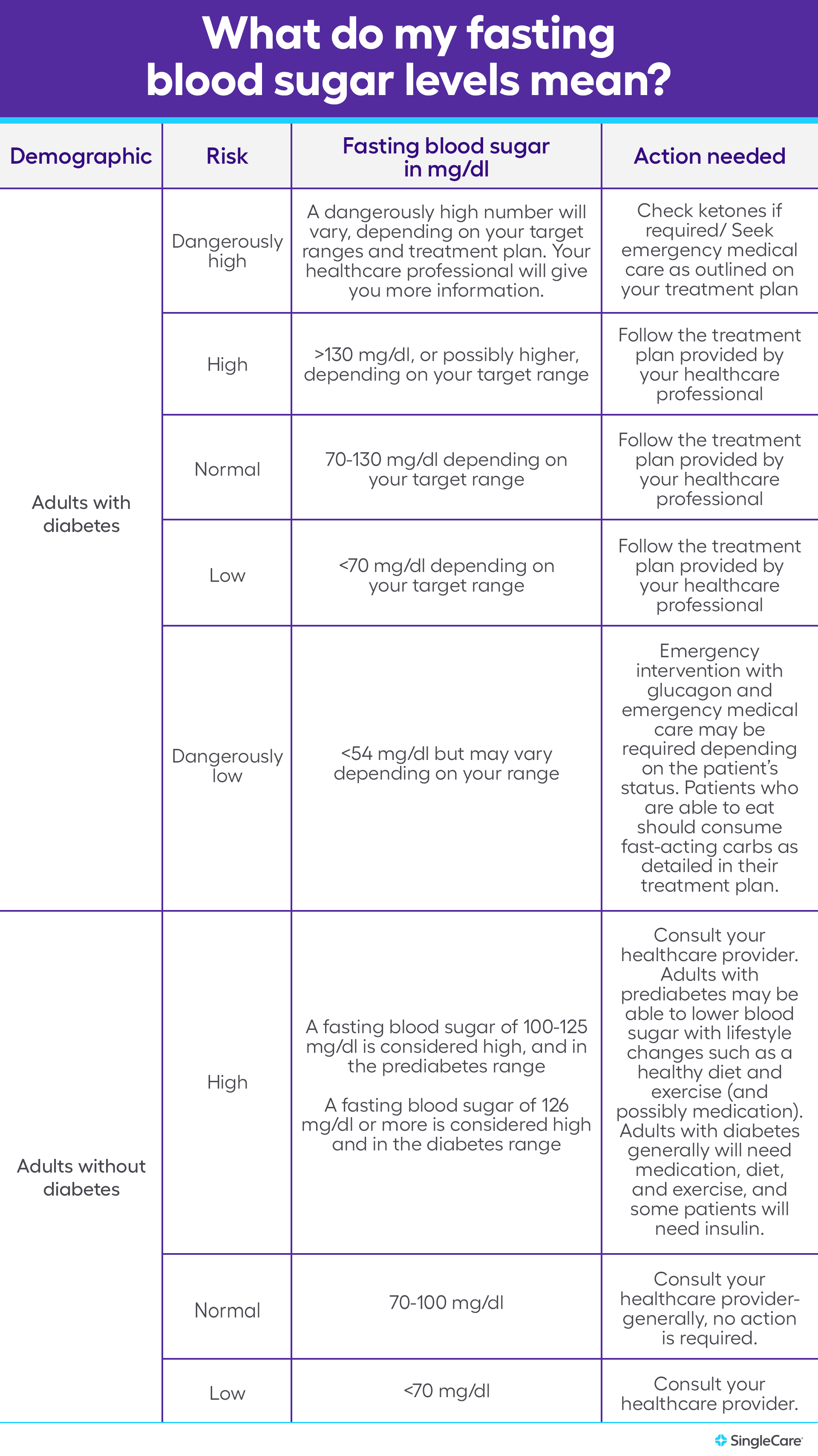
What do my fasting blood sugar levels mean? |
|||
|---|---|---|---|
| Demographic | Risk | Fasting blood sugar in mg/dl | Action needed |
| Adults with diabetes | Dangerously high | A dangerously high number will vary, depending on your target ranges and diabetes care plan. Your healthcare professional will give you more information. | Check ketones if required, as diabetic ketoacidosis (excess acid in the blood) can occur. Seek emergency medical care as outlined on your treatment plan. |
| High | >130 mg/dl, or possibly higher, depending on your target range | Follow the treatment plan provided by your healthcare professional | |
| Normal | 70-130 mg/dl depending on your target range | Follow your treatment plan provided by your healthcare professional | |
| Low | <70 mg/dl depending on your target range | Follow your treatment plan provided by your healthcare professional | |
| Dangerously low | <54 mg/dl but may vary depending on your range | A dangerously low blood sugar can be life-threatening. Emergency intervention with glucagon and emergency medical care may be required depending on the patient’s status. Patients who are able to eat should consume fast-acting carbs as detailed in their treatment plan. | |
| Adults without diabetes | High | A fasting blood sugar of 100-125 mg/dl is considered high and in the prediabetes range A fasting blood sugar of 126 mg/dl or more is considered high and in the diabetes range | Consult your healthcare provider. Adults with prediabetes may be able to lower blood sugar with lifestyle changes such as a healthy diet and exercise (and possibly medication). Adults with diabetes generally will need medication, diet, and exercise, and some patients will need insulin. |
| Normal | 70-99 mg/dl | Consult your healthcare provider. Generally, no action is required. | |
| Low | <70 mg/dl | Consult your healthcare provider |
Download this fasting blood sugar levels chart here.
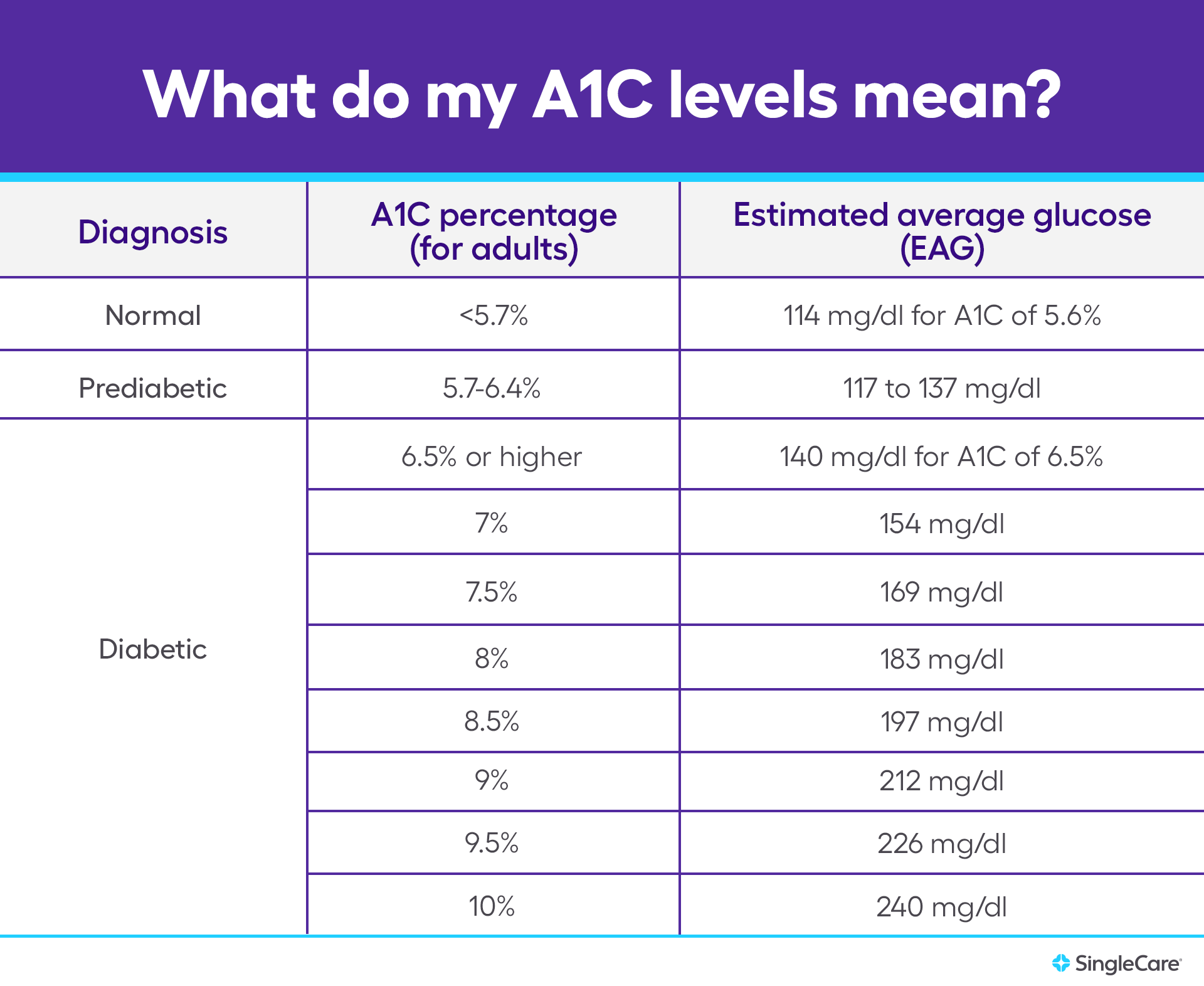
The chart below converts A1C levels into an average blood sugar level. You can access this calculator to find your average blood sugar level if your exact A1C is not listed in the chart.
What do my A1C levels mean? |
||
|---|---|---|
| Diagnosis | A1C percentage (for adults) | Estimated average glucose (EAG) |
| Normal | <5.7% | 114 mg/dl for A1C of 5.6% |
| Prediabetic | 5.7-6.4% | 117 to 137 mg/dl |
| Diabetic | 6.5% or higher | 140 mg/dl for A1C of 6.5% |
| 7% | 154 mg/dl | |
| 7.5% | 169 mg/dl | |
| 8% | 183 mg/dl | |
| 8.5% | 197 mg/dl | |
| 9% | 212 mg/dl | |
| 9.5% | 226 mg/dl | |
| 10% | 240 mg/dl |
Download this A1C average blood sugar chart here.
RELATED: Learn more about normal A1C levels here
Testing for diabetes
If you have risk factors for diabetes or symptoms of high blood glucose, your healthcare provider may order a blood sugar test to determine whether you have diabetes or prediabetes. There are different types of tests for different types of diabetes. The most common tests for Type 1 diabetes, Type 2 diabetes, prediabetes, and gestational diabetes are:
Hemoglobin A1C tests (HbA1C): These measure average blood sugar levels over a three-month period and are performed in a healthcare provider’s office or lab using a blood sample from the finger or arm. The A1C test does not require fasting beforehand.
Fasting blood glucose tests: These are performed similarly to A1C tests but require fasting for 8–12 hours beforehand.
Glucose screening tests (also called glucose challenge tests): These are performed to test for gestational diabetes. They involve drinking a glucose-rich liquid and having blood drawn one hour later to check blood sugar levels. Levels exceeding 140 mg/dl require patients to take a glucose tolerance test to diagnose gestational diabetes.
Glucose tolerance tests: These are similar to glucose screening tests but involve fasting for 8–12 hours beforehand and having blood drawn at one-hour intervals for up to three hours afterward.
How to monitor blood sugar
If you’re diagnosed with diabetes, your healthcare provider or diabetes educator will tell you how often to check your blood sugar at home. One way is to use a blood glucose monitor to check your blood sugar. This method uses a finger stick device (called a lancing device), which holds a lancet to get a drop of blood. Then, you put a drop of blood on a test strip, which is inserted into the monitor. The monitor will then give you a reading of your blood sugar.
Another method of checking blood sugar is by using a continuous glucose monitor (CGM). This method places a sensor on the body, with a tiny attachment that goes under the skin. CGMs monitor interstitial blood sugar, the sugar found in fluid between cells. The data is transmitted to a receiver or an app on the patient’s mobile phone. Glucose data is updated every one to five minutes, depending on the CGM. This is especially useful in patients who use insulin and need frequent readings to make treatment decisions.
Your healthcare provider will give you more information on what to do if your blood sugar is too low. For example, they may recommend consuming 15 grams of fast-acting carbohydrates such as apple juice, Smarties, or glucose tablets. Or, if your blood sugar is too high, they may recommend administering insulin, depending on your condition.
Frequently asked questions about blood sugar
When should you check your blood sugar, and why?
Your healthcare provider will tell you how often to monitor your blood sugar. People with diabetes, especially those who use insulin, will need to monitor blood sugar much more frequently than those with prediabetes or normal blood sugar. People with normal blood sugar may only require periodic testing, for example, once yearly, at their physical examination. Maintaining blood sugar in the target range is important in preventing long-term diabetes complications.
What is the difference between A1C and blood sugar?
A blood sugar level measures the amount of glucose, or sugar, in your blood at that exact moment. On the other hand, an A1C is a measure of blood glucose control over a period of about three months.
Blood sugar levels can be converted to an average A1C and vice versa. There are many calculators online that can convert these numbers. For example, an A1C of 6.3% translates to an average blood sugar of 134 mg/dl. You can talk more with your healthcare professional about your numbers and what they mean.
A patient may have an excellent A1C but have lots of highs and lows, while another could have an excellent A1C and have a very steady number that is usually in the target range. People who use a CGM can benefit from aiming for a “time in range” of at least 70%. The time in range is the amount of time spent in your target blood sugar range—not too high or too low. Having consistent normal blood glucose levels can help prevent long-term complications from diabetes.
What are dangerous blood sugar levels?
Blood sugar can be dangerously high—or dangerously low. Your healthcare provider will give you individual target ranges and tell you when to take action on dangerously high or low blood sugar levels. These numbers, especially high numbers, differ by individual. Hypoglycemia (low blood sugar) is generally defined as a blood sugar less than 70 mg/dl, but it can vary depending on the individual. Severe hypoglycemia may occur if your blood sugar drops to a level where you need help recovering. Your healthcare provider may prescribe glucagon that a trained family member or caregiver can administer to you in a low blood sugar emergency.
[singlecare_dynamic_newsletter_form heading='Get our diabetes newsletter' submit='Click to sign up' subsource='Diabetes Newsletter']
What should your blood sugar levels be in the morning?
For people without diabetes, normal fasting blood sugar is less than 100 mg/dl, generally 70–99 mg/dl. Patients with diabetes will have target ranges recommended by their healthcare provider, generally between 70–180 mg/dl, depending on age and other factors.
What are the target blood sugar levels for Type 1 vs. Type 2 diabetes?
Regardless of which type of diabetes you have, it is important to stay in the target range as much as possible to avoid long-term complications. Your healthcare provider will tell you your target ranges and give you more information on how to stay in the appropriate ranges.
Oral glucose tolerance test during pregnancy, Cleveland Clinic (2022)
eAG/A1C conversion calculator, American Diabetes Association
CGM & time in range, American Diabetes Association
Low blood glucose (hypoglycemia), American Diabetes Association
Subscribe to our savings newsletter
Health education, drug info, wellness & more
By clicking 'Subscribe', I agree to SingleCare's Terms & Conditions.