Bacterial vaginosis
BV symptoms: What are the early signs of BV?


Overview: What does BV feel like?
Bacterial vaginosis (BV) is an overgrowth of certain types of vaginal bacteria. It is a disturbance in the balance of bacteria that normally lives in the vagina, not an infection. BV happens when there is a decrease in a particular type of bacteria, lactobacilli, which then allows other types of bacteria to multiply. Although sexual activity is a significant risk factor, bacterial vaginosis is not a sexually transmitted infection (STI) because the bacteria are usually found in the vagina. Additionally, some women who are not sexually active can have BV.
Most women will first notice a change in their usual vaginal discharge. BV causes a thin white, yellow, or gray vaginal discharge that has a strong odor. Sometimes it’s described as smelling “fishy.” Some women will also have pain when they urinate or have sex. Itching in and around the vagina can also be a problem. While not a medical emergency, only 30% of cases resolve without treatment. However, BV usually improves with treatment, so it’s a good idea to see a healthcare provider if you have symptoms.
Key takeaways:
BV is a common health condition that affects the vagina.
Early signs of BV include an unpleasant-smelling white, yellow, or grayish vaginal discharge.
BV does not require immediate medical attention unless someone is pregnant.
BV is caused by the overgrowth of certain bacteria that typically live in the vagina. You may be at higher risk for BV if you douche, smoke, use an intrauterine device (IUD), have multiple or new sexual partners, do not use barrier protection for sex, or are pregnant.
BV usually requires a medical diagnosis.
Symptoms of BV generally require treatment. They typically resolve with treatment within a few days.
Treatment of BV may include oral or topical antibiotics. Read more about BV treatments here.
Untreated BV could increase the risk of STDs and pregnancy complications.
Use coupons for metronidazole, clindamycin, and tinidazole to save up to 80%.
What are the early signs of BV?
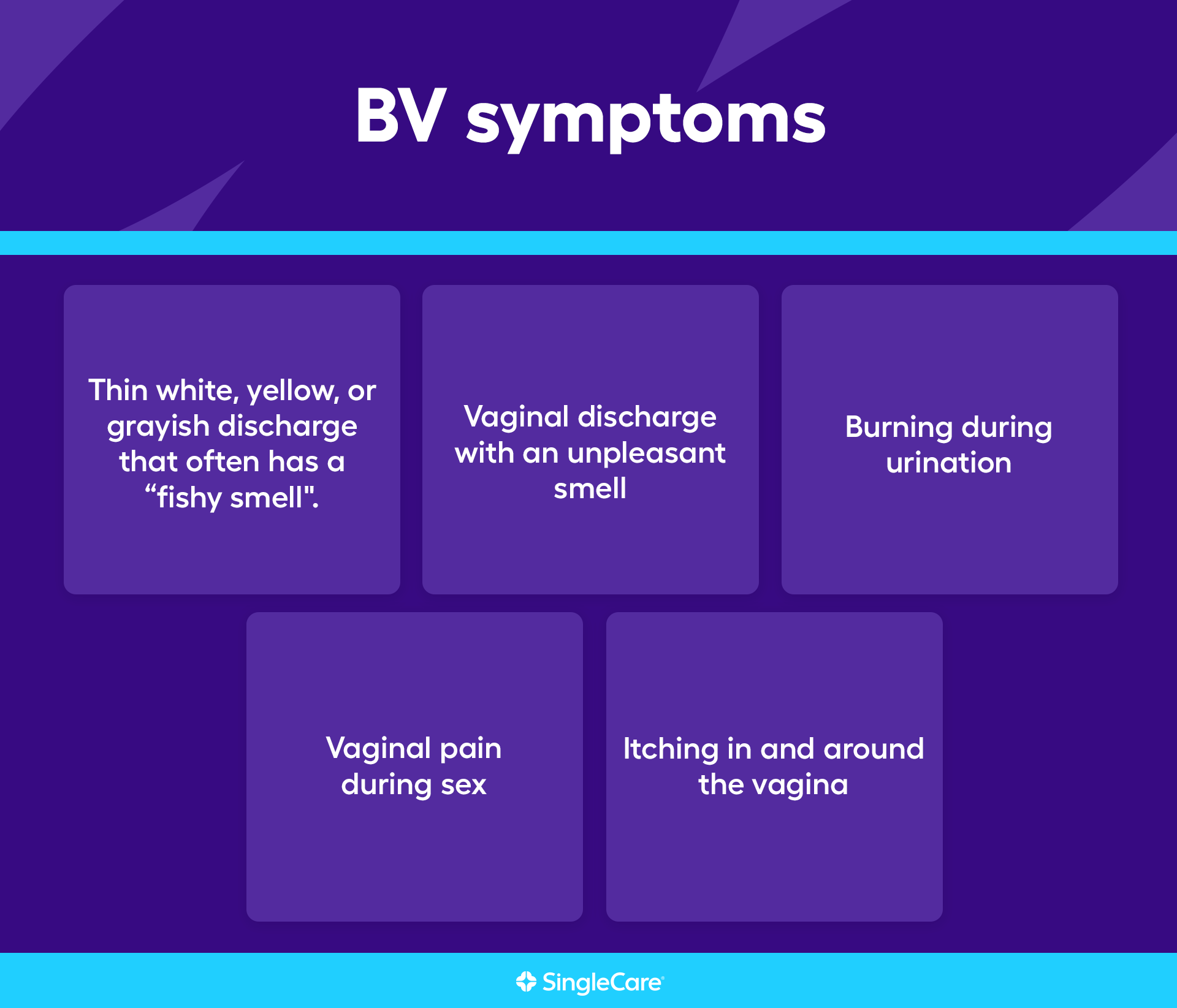
The most common symptom of BV is a thin white, yellow, or grayish discharge that often has a “fishy smell.” For some people, the discharge will increase after intercourse.
Other BV symptoms
The symptoms of bacterial vaginosis may include:
Vaginal discharge with an unpleasant smell
Burning during urination
Vaginal pain during sex
Itching in and around the vagina
It’s less common, but there may also be no symptoms at all.
BV vs. yeast infection symptoms
Bacterial vaginosis is easily mistaken for a vaginal yeast infection, another common health condition. It’s important to distinguish the two correctly. Over-the-counter yeast infection medications will not help relieve BV symptoms. Prescription antibiotics are the only treatments proven to be effective for BV. Symptoms of the two conditions may be similar: vaginal discharge, irritation, burning, itching, and pain. However, the vaginal discharge with BV is thinner and has a more distinctive odor. A yeast infection produces a thicker discharge with little smell and more itching.
| BV | Yeast infection | |
| Shared symptoms |
|
|
| Unique symptoms |
|
|
When to see a healthcare professional for BV symptoms
Bacterial vaginosis can be successfully treated. However, unlike a yeast infection, BV cannot be treated with over-the-counter medications. Not all cases of BV will resolve without treatment, so see a healthcare provider for symptoms.
A healthcare professional will take a medical history, do a physical examination and a pelvic exam, and use a swab to take fluid and surface cell samples from the vagina. One goal of the examination and lab studies is to rule out other problems like a yeast infection or an STI.
The diagnosis is usually made by examining bacteria from a vaginal sample under a microscope. However, BV may also be diagnosed by noting these four signs:
A thin discharge that coats the inside of the vagina
The discharge has a “fishy odor” when potassium hydroxide is added to it (the “whiff test”)
The pH of the vaginal fluid is higher than 4.5 (the expected value is between 4.0 and 4.5)
A microscopic examination reveals cells with bacteria stuck to them (“clue cells”)
Meeting three of these criteria is considered enough to make a diagnosis, but other tests are sometimes used. Additional testing will add to the cost of diagnosis.
Complications of BV
Untreated BV can lead to complications such as:
Recurrence (up to 80% of women with BV will have recurrent bouts)
Sexually-transmitted infections (STIs) including HIV, HPV, gonorrhea, genital herpes, chlamydia, and trichomoniasis
Pregnancy complications such as preterm delivery, miscarriage, membrane rupture, and postpartum infection
BV may increase the risk of e pelvic inflammatory disease (PID), but that risk is unclear.
How to treat BV symptoms
Bacterial vaginosis is treated with antibiotics, either taken by mouth or applied vaginally as a cream or gel. The most commonly used are Flagyl (metronidazole) and Cleocin (clindamycin), both available as pills or in topical formats. Both are safe for pregnant women.
About 10% to 15% of women with BV do not improve after the first round of treatment. In those cases, they may need another round of metronidazole or clindamycin. However, the healthcare provider may also prescribe tinidazole as an alternative.
Male sex partners don’t need to be treated. But female partners should be evaluated and treated if BV is present.
Living with BV
Eighty percent of those who have a bout with BV will have it again in the future. Recurrent BV is believed to be related to the nature of the bacteria. One of the bacteria species forms a biofilm: a thin, slimy gel that sticks to the surface of the vagina and glues all the bacteria together. As a result, it’s hard for antibiotics to reach all the bacteria inside the film.
People are understandably unhappy when BV recurs. They may be tempted to try home remedies, including over-the-counter treatments, antiseptic creams, home test kits, douching products, yogurt, vaginal deodorants, probiotics, and dietary supplements. Some treatments, like dietary changes, may support the growth of healthy bacteria. Others don’t help, and some, like douching, may make the problem worse. The only proven way to relieve the symptoms of bacterial vaginosis is to take a course of antibiotics.
A few lifestyle changes have been shown to reduce the incidence of recurrent BV:
Don’t use vaginal douches
Use condoms during sex, particularly with new sex partners, even when using another form of contraception
Limit the number of sex partners
Stop smoking
Most importantly, get treatment from a healthcare professional
While there are home testing kits for bacterial vaginosis, they are not always accurate, and over-the-counter treatments have not been proven to work. A healthcare professional can diagnose and treat the infection and ensure nothing more serious is happening.
FAQs about BV symptoms
What does BV smell like?
BV is characterized by a thin vaginal discharge with an unpleasant smell that people describe as “fishy.” Sometimes the smell gets stronger during sexual intercourse. Whether the smell is very mild or strong, one of the diagnostic criteria is the “whiff test.” When potassium hydroxide is added to a sample of the discharge, it will emit a strong fishy odor if it's due to BV.
How long does BV last?
BV does not often resolve without treatment. However, when treated with antibiotics, the bacterial overgrowth should clear within a few days. It’s important to take the full course of antibiotics as prescribed.
Can I test for BV at home?
There are two types of at-home BV tests. The first measures the pH of vaginal fluid, but it’s not definitive. A pH result above a certain level indicates that you should see a healthcare provider. The second type involves sending a sample to a laboratory for analysis. These are more expensive, and the results will take a few days. Some may be very accurate for BV, and others less so. Again, a positive test is a good indication to see a healthcare professional for treatment. A serious flaw with home BV tests is that they don’t always test for other possible problems. And you will still need to see a healthcare professional for treatment.
What’s next? Additional resources for people with BV symptoms
Test and diagnostics
Bacterial vaginosis, Centers for Disease Control and Prevention (CDC)
Bacterial vaginosis, Office on Women’s Health
Bacterial vaginosis, StatPearls
Vaginitis: diagnosis and treatment, American Family Physician
Treatments
Bacterial vaginosis, Centers for Disease Control and Prevention (CDC)
Bacterial vaginosis, StatPearls
Bacterial vaginosis—CDC basic fact sheet, Centers for Disease Control and Prevention (CDC)
Bacterial vaginosis treatments and medications, SingleCare
Scientific studies and clinical trials
Aerobic vaginitis is late pregnancy and outcomes of pregnancy, European Journal of Clinical Microbiology & Infectious Diseases
Bacterial vaginosis biofilms: challenges to current therapies and emerging solutions, Frontiers in Microbiology
Does bacterial vaginosis cause pelvic inflammatory disease?, Sexually Transmitted Diseases
Risk of bacterial vaginosis in users of the intrauterine device: a longitudinal study, Sexually Transmitted Diseases
More information on related health conditions
Trichomoniasis treatments and medications, SingleCare
Vaginal candidiasis, StatPearls
Yeast infection treatments, and medications, SingleCare
Subscribe to our savings newsletter
Health education, drug info, wellness & more
By clicking 'Subscribe', I agree to SingleCare's Terms & Conditions.








