Report: Flu season suppressed amid COVID-19 pandemic
In the summer of 2020, health experts warned that the fall and winter months could be especially dangerous for public health in America with a potentially devastating combination of COVID-19 and the flu season. The threat of a “twindemic” raised concern among experts that hospital systems could become overwhelmed, which is why they stressed the importance of everyone getting a flu vaccine. Flu season typically starts in October and peaks between December through February. When looking back at the 2019-2020 flu season, the Centers for Disease Control and Prevention (CDC) estimated that there were between 39-56 million flu illnesses, a particularly high estimate.
Fortunately, the “twindemic” has yet to come to fruition, and, in fact, flu activity has been unusually low. The CDC has reported that from the week of September 27, 2020 to the week of January 16, 2021, there have been a total of 1,159 positive flu cases in the U.S., which is pacing dramatically lower than last year’s counts:
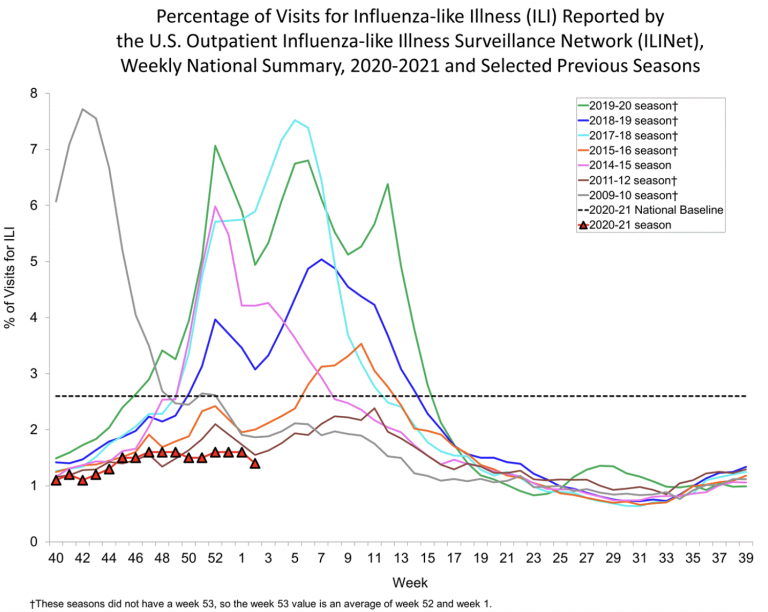
Credit: CDC
SingleCare analyzed fill data for flu-related medications and vaccines to see how this year compares to previous years and whether more Americans received flu vaccinations in light of the pandemic.
Americans answer the call for flu vaccination: Overall, fills increase 50%, driven by a significant increase among the population under 17
SingleCare analyzed the fill data August to December 2020 to the same time period in 2019 and found that fills rose by 50%, peaking in October. Interestingly, according to SingleCare data, the age 65 and over cohort, which is typically most vulnerable to the flu, saw a decrease in fills by 13% while the 1-17 age group saw a 109% increase. The CDC recommends that those over the age of 6 months should get their flu vaccine by the end of October; however, it should continue to be offered throughout the entirety of the flu season. In a recent interview, Dr. Anthony Fauci, director of the National Institute of Allergy and Infectious Diseases, also stated that he typically gets his flu shot toward the middle or end of October and emphasized the importance of getting a flu vaccine this year.
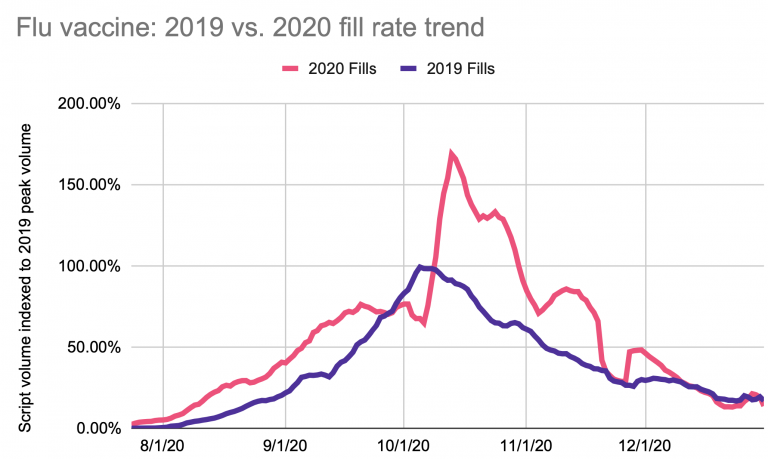
“This fall surge in fills for the flu vaccine is likely one of the contributing reasons why we’ve seen record low flu cases this year,” said Ramzi Yacoub, Pharm.D., the chief pharmacy officer at SingleCare. “Between social-distancing practices during the pandemic and more Americans getting vaccinated, it has made the flu practically non-existent during a time when we’re usually entering the peak season.”
Top flu medication sees drastic decrease in volume due to mild flu season
Oseltamivir phosphate, the generic version of Tamiflu, is an antiviral medication used to treat and prevent the flu. Based on SingleCare fill trends from 2018 and 2019, this drug typically begins to rise in fills in December and maintains high volume throughout February. However, when comparing the fill volume for December 2020 to December 2019, SingleCare saw that fills for the drug decreased by 97%. Additionally, using the preliminary fill volume of the first 13 days in January 2021 compared to the same time period last year, SingleCare has seen a 98% decrease in fills for the drug.
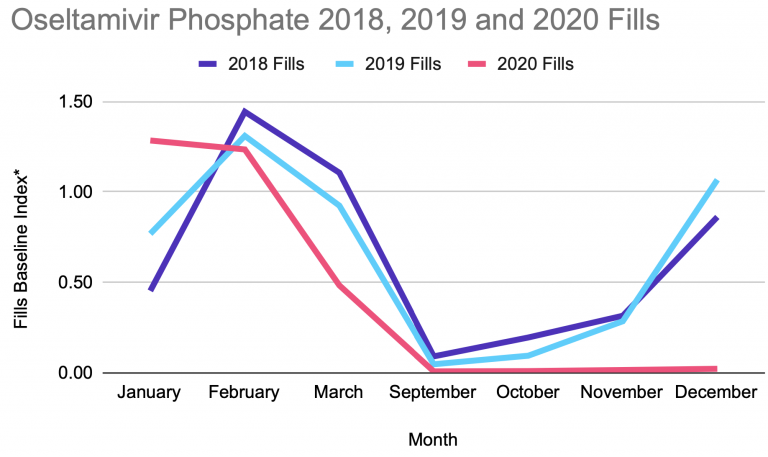
*Baseline is the average of the first three months of 2018, 2019, and 2020 for oseltamivir phosphate
If you haven’t already, it it still important to get a flu shot this year
While flu illnesses remain low this season, it doesn’t guarantee there won’t be an uptick later in the season. “Even though flu cases are currently lower than usual, it doesn’t mean we’re out of the woods yet,” said Dr. Yacoub. “People should remain vigilant about the possibility of an outbreak and as we enter peak flu season, it’s still important for people to get their flu shot if they haven’t already.” According to Dr. Yacoub, the best way for people to stay healthy during the flu season is to practice social distancing, regularly wash your hands, wear a mask when around others, and always stay home if you are feeling sick.
Methodology
Data analyzed include both prescription medications and vaccines filled by SingleCare consumers during 2018, 2019, and 2020. Data was reviewed and analyzed by the SingleCare team as of Jan. 21, 2021.
Subscribe to our savings newsletter
Health education, drug info, wellness & more








