




 Search for articles or Rx savings


Key takeaways
Mixing alcohol and Depakote can increase drowsiness, dizziness, and seizures, among other problems.
Older people and those with kidney problems may have higher risks of side effects when combining Depakote and alcohol.
Some people may be able to drink in moderation with Depakote, with the risks of side effects increasing with larger amounts of alcohol.


Healthcare providers generally recommend avoiding alcohol while taking Depakote, especially when first starting the medication. That’s because side effects are more likely to come up within the first few days or weeks of starting a new drug. Drinking while taking Depakote could worsen some side effects, like drowsiness, which could make it dangerous to drive or operate machinery.
Those who’ve been taking the medication for a while and know how it affects them may be able to get away with limiting alcohol intake instead of completely avoiding it. Drinking in moderation means no more than two drinks per day for men and no more than one drink per day for women. In many cases, however, healthcare providers recommend avoiding alcohol use completely, as it can worsen the conditions that Depakote is being used to treat.
Interestingly, healthcare providers sometimes prescribe Depakote off-label for alcohol withdrawal, with research showing it may help reduce alcohol cravings in people with alcohol use disorder. Still, using Depakote like this is different from taking it for another condition while drinking recreationally.
Save up to 80% on Depakote with SingleCare
Different pharmacies offer different prices for the same medication. SingleCare helps find the best price for you.


Can you drink while taking Depakote?
Healthcare providers generally recommend avoiding alcohol while taking Depakote, especially when first starting the medication. That’s because side effects are more likely to come up within the first few days or weeks of starting a new drug. Drinking while taking Depakote could worsen some side effects, like drowsiness, which could make it dangerous to drive or operate machinery.
Those who’ve been taking the medication for a while and know how it affects them may be able to get away with limiting alcohol intake instead of completely avoiding it. Drinking in moderation means no more than two drinks per day for men and no more than one drink per day for women. In many cases, however, healthcare providers recommend avoiding alcohol use completely, as it can worsen the conditions that Depakote is being used to treat.
Interestingly, healthcare providers sometimes prescribe Depakote off-label for alcohol withdrawal, with research showing it may help reduce alcohol cravings in people with alcohol use disorder. Still, using Depakote like this is different from taking it for another condition while drinking recreationally.
What happens if you mix Depakote and alcohol?
Alcohol doesn’t directly interact with Depakote. However, mixing Depakote with alcohol can cause severe side effects that can affect the body in different ways. In particular, mixing the two can strain the liver and worsen mental health symptoms.
Increased drowsiness or dizziness
Drowsiness and dizziness are common side effects of Depakote that can be intensified with even just one drink of alcohol. The combination can make it hard to think clearly or stay balanced while walking. Some people may also feel groggy and confused for hours after drinking. As a result, things like climbing up stairs or driving can quickly turn dangerous.
Increased seizure risks
People who drink alcohol while taking Depakote may experience an increased risk of seizures. Alcohol is a well-known trigger of seizures. However, the caveat is that the risk of seizures is directly linked to the amount of alcohol consumed. In other words, small amounts of alcohol aren’t likely to cause seizures, but binge drinking more than three beverages may increase the risk. Therefore, alcohol could reduce the effectiveness of Depakote or lead to life-threatening seizures, especially in people who tend to miss their doses of Depakote.
Liver problems
Depakote carries a black box warning for an increased risk of liver problems, especially during the first six months of treatment. Although liver problems from Depakote are more common in children younger than 2, adults can also experience them. For this reason, people with liver disease shouldn’t take Depakote at all. Alcohol can also damage the liver, although the risk of damage is higher with large amounts of alcohol over time. Those who regularly drink several glasses of alcohol could face higher risks of liver problems while taking Depakote.
Worsened mental health symptoms
Depakote is effective for treating manic episodes of bipolar disorder. However, it can also cause suicidal thoughts or behaviors in some people. Drinking alcohol is associated with worsened mental health symptoms, potentially intensifying depression and mood swings in people with bipolar disorder who take Depakote. Someone might feel like their medication stopped working when, in reality, alcohol is counteracting the drug’s benefits.
Inflammation of the pancreas
Depakote can sometimes cause pancreatitis, or swelling of the pancreas, which can sometimes be life-threatening. Heavy alcohol use can also increase this risk, although a study showed that patients who experienced pancreatitis from alcohol were drinking several drinks per day over a long period. Pancreatitis can cause fever, nausea, and severe stomach pain that spreads to the back, often requiring immediate medical care.
Bleeding problems
Depakote may affect blood clotting, which could lead to an increased risk of bleeding. People may bruise easily or have trouble stopping bleeding from small cuts. In severe cases, internal bleeding can occur without obvious signs. Alcohol can also sometimes act as a blood thinner, potentially increasing the bleeding effects of Depakote. Someone who takes other blood thinners may be at a higher risk of serious bleeding problems while drinking alcohol and taking Depakote.
Are certain people at greater risk of side effects?
Certain people may be more likely to experience side effects when mixing Depakote and alcohol. For example, older adults and those with kidney or liver problems could have more severe complications.
Older adults
Adults 65 and older process alcohol and medications more slowly than younger adults. In most cases, older adults will start with a lower dose of Depakote due to an increased risk of more severe side effects.
Potential risks for older adults taking Depakote include:
- Increased drowsiness and confusion
- Higher chance of falls and serious injuries
- Trouble concentrating or driving
- More severe coordination problems
People with liver problems
The liver is responsible for processing Depakote and alcohol. Those with liver problems could experience severe complications like further liver damage while taking Depakote or alcohol. That’s why it’s safest to skip alcohol and Depakote altogether with liver disease.
People with kidney problems
People with kidney disease have difficulty filtering medications and toxins from their blood as effectively as those with healthy kidneys. Therefore, they may have trouble clearing substances like Depakote or alcohol from the body, leading to higher levels of both—a recipe for serious side effects. Drinking alcohol can also cause worsened kidney function over time.
People taking other medications
Mixing Depakote with other medications, supplements, or even certain over-the-counter (OTC) drugs can increase the risk of side effects, especially if alcohol is involved. Drug interactions can change how Depakote works in the body or lead to unexpected effects.
Drugs that can interact with Depakote and lead to greater problems when alcohol is added include:
- Elavil (amitriptyline) and Pamelor (nortriptyline): These antidepressants may need to be adjusted when taken with Depakote. Adding alcohol to the mix can increase drowsiness or unsteadiness.
- Epidiolex (cannabidiol): Taking this with Depakote can affect the liver by increasing liver enzymes. Drinking alcohol on top of that can put even more stress on the liver.
- Merrem (meropenem): This antibiotic can lower how much Depakote stays in the body, which could lead to more complications like increased seizures if alcohol is also involved.
- Rifadin (rifampin): This medication speeds up how the body clears Depakote. Alcohol can make these effects more unpredictable.
- Aspirin: This common OTC drug can interact with Depakote, increasing the risk of bleeding. This effect may be compounded if alcohol is also consumed.
Always discuss other medications being taken before starting Depakote, and especially if you drink alcohol regularly.
How long after taking Depakote can you drink alcohol?
Depakote has a half-life of nine to 16 hours in most adults. A half-life means the time it takes for half of the drug to leave someone’s body. It typically takes around five half-lives for a drug to be cleared from the body. This means Depakote could stay in the body for 45 to 80 hours after the last dose.
Regular Depakote delayed-release tablets and Depakote sprinkle capsules are usually taken two or three times daily. Depakote ER is an extended-release tablet that is taken once per day. The dosage depends on individual weight, age, and medical condition.
It’s best to wait at least three to four days after stopping Depakote before drinking alcohol. Waiting this amount of time can give the body enough time to remove most of the medication and reduce the risk of dangerous effects from Depakote and alcohol.
In any case, Depakote should never be stopped suddenly without talking to a healthcare provider first. Abruptly stopping Depakote could lead to rebound symptoms of the conditions it’s being used to treat.
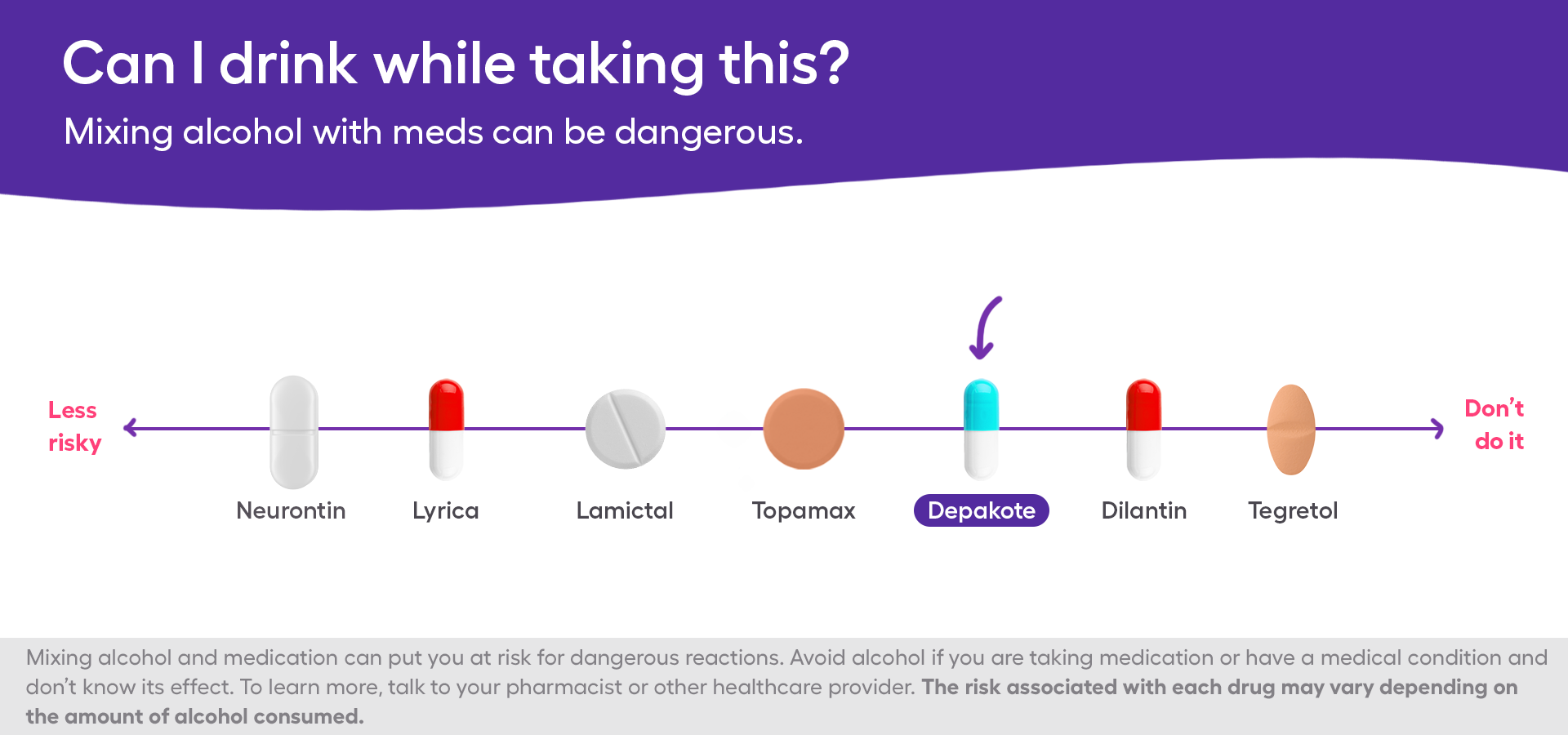
Which anticonvulsant medications are not affected by alcohol?
Almost all antiepileptic medications don’t mix well with alcohol because they have overlapping side effects, like drowsiness and dizziness. In addition, alcohol can make seizure medications less effective since it can trigger seizures in some people.
How a person reacts depends on things like how long they’ve been on the medication and how much they drink. If we’re talking about drinking in moderation, it can be hard to tell which anticonvulsants can be safely taken since medications and alcohol affect everyone differently.
Other anticonvulsant medications that may be dangerous with alcohol include:
- Tegretol (carbamazepine)
- Lamictal (lamotrigine)
- Topamax (topiramate)
- Dilantin (phenytoin)
- Luminal (phenobarbital)
- Felbatol (felbamate)
- Klonopin (clonazepam)
- Valium (diazepam)
People taking seizure medications should always talk to their healthcare provider before drinking alcohol. Even small amounts can sometimes cause problems depending on the person and their overall health condition.
The bottom line
Mixing Depakote with alcohol isn’t usually safe and can lead to serious side effects like drowsiness, dizziness, or even seizures. The combination can also worsen mental health and increase bleeding problems, especially with large amounts of alcohol. While some people may tolerate small amounts of alcohol, the risks of problems are higher for older adults and those with liver or kidney problems. Anyone taking Depakote should seek medical advice from a healthcare provider before drinking alcohol.
- Depakote highlights of prescribing information, U.S. Food and Drug Administration (2025)
- Drink alcohol only in moderation, U.S. Department of Health and Human Services (2025)
- The use of divalproex in alcohol relapse prevention: A pilot study, Drug and Alcohol Dependence (2002)
- Alcohol as a seizure trigger, Epilepsy Foundation (2024)
- Depakote drug label information, DailyMed (2025)
- Alcohol-related liver disease, Yale Medicine
- Mental health and alcohol, drugs and tobacco: A review of the comorbidity between mental disorders and the use of alcohol, tobacco and illicit drugs, Drug and Alcohol Review (2006)
- Study: Long-term alcohol consumption plays role in pancreatitis progression, Cedars Sinai (2023)
- Alcohol’s effects on the cardiovascular system, Alcohol Research (2017)
- Alcohol and age: A risky combination, Harvard Health Publishing (2018)
- Extended-release divalproex in bipolar and other psychiatric disorders: A comprehensive review, Neuropsychiatric Disease and Treatment (2007)
- Valproic acid, StatPearls (2024)