






Key takeaways
46% of respondents have used AI to answer medication-related questions.
49% of AI users said AI guidance changed how they took a medication.
78% believed AI-generated medication information is somewhat accurate.
According to SingleCare’s survey of 1,000 Americans, nearly half of respondents have used AI to make decisions about their medications, and many have acted on its recommendations. Our new survey reveals how Americans are turning to tools like ChatGPT to research medications, such as side effects and prescription costs, highlighting both rapid adoption and growing risks in how people manage their health.
Who uses AI for medication questions?
Almost half of U.S. respondents (46%) say they have used AI tools to answer medication-related questions, signaling that AI is already gaining meaningful traction in medication management.
AI use patterns vary across demographics, indicating that comfort with technology, access, and trust all play a role in shaping the extent to which different groups consult AI for medication guidance:
- Women (44%) were less likely than men (50%) to use AI to answer medication-related questions.
- Parents, particularly those with two or more children (62%), were more likely to rely on AI for medication guidance than people with no children younger than 18 living at home (42%).
- People with a household income of $100K+ were more likely to use AI to compare medication alternatives (46% vs. 26%), decide whether to seek care for a health problem (45% vs. 30%), interpret lab results (34% vs. 24%), and get a prescription (44% vs. 34%) than those with a household income of less than $50K.
- The adoption of AI for medication information was stronger among younger adults, but skepticism was higher in this age group.
- Reported use of AI for medication research was similar across ages 18-54 (51%) and decreased at age 55 and older (38%).
- More than half (56%) of younger adults aged 18-24 reportedly used AI for medication questions, and 80% said they verified the information.
- Only 38% of adults aged 55+ reportedly used AI for medication research, and just 56% reported verifying AI-generated information.
AI for medication research by age group |
|||
|---|---|---|---|
| Age group | Used AI for medication research | Changed how they took their meds based on AI info | Acted on AI advice w/out consulting doctor |
| 18-24 years old | 56% | 58% | 17% |
| 25-34 years old | 44% | 49% | 34% |
| 35-44 years old | 55% | 38% | 27% |
| 45-54 years old | 51% | 36% | 27% |
| 55-64 years old | 43% | 28% | 20% |
| 65-74 years old | 33% | 27% | 20% |
| 75+ years old | 35% | 23% | 23% |
What people are asking AI
Most users turned to AI for basic medication research, but many were also using it to guide decisions. Of those who reportedly used AI to answer questions related to medication:
- 51% researched what a medication is and what it’s used for
- 44% looked up side effects or dosage recommendations
- 37% decided whether to seek care for a health problem
- 34% checked drug interactions
- 34% compared or identified medication alternatives
- 26% interpreted lab results
Still, 23% reported using AI for none of these purposes, suggesting ongoing hesitation from nearly a quarter of respondents.
“Just in the past few weeks, patients have come to office visits with specific AI-related queries and answers,” says Leslie Greenberg, MD. “Last month, I had a woman ask to ‘optimize’ her hormones and request an extensive lab panel. These labs are available but not routinely used in menopausal hormone therapy because they rarely alter treatment or management.”
AI use cases by age |
||||||
|---|---|---|---|---|---|---|
| Age group | 18-24 | 25-34 | 35-44 | 45-54 | 55-64 | 65+ |
| Researched what a medication is | 39% | 51% | 51% | 61% | 52% | 51% |
| Researched side effects & dosage | 35% | 57% | 40% | 49% | 45% | 36% |
| Decided whether to seek health care | 39% | 54% | 35% | 37% | 28% | 25% |
| Checked drug interactions | 18% | 51% | 37% | 38% | 27% | 30% |
| Compared/found medication alternatives | 32% | 49% | 35% | 44% | 23% | 17% |
| Interpreted lab results | 20% | 42% | 27% | 25% | 24% | 19% |
AI is influencing medication decisions
We asked survey respondents whether AI helped guide them in taking their medication. Almost half (49%) of respondents changed the way they took their medication based on AI information.
Of those who used AI to help guide them on how to take their medication:
- 25% used an alternative (OTC or natural)
- 23% started a medication
- 20% changed dosage
- 18% changed timing
- 16% stopped a medication
Although most users still sought validation, a quarter of respondents acted on AI advice without consulting a healthcare professional.
“Two patients recently told me about using AI to help understand an aspect of their health,” says Chad Shaffer, MD. “One had used an AI model to generate dietary suggestions to mitigate the nausea and constipation side effects of Zepbound use for weight management. The ideas included increasing water and fiber consumption, along with avoiding large, fatty, and late-night meals. I reinforced the advice when asked, and the patient has turned the corner with both medication tolerance and efficacy.”
“Another patient discontinued metformin after asking AI for the potential side effects of their diabetic medication regimen,” Dr. Shaffer says. “They had not been experiencing symptoms of any adverse effects, but were afraid of long-term impacts. After we discussed the relatively low risk of medication side effects and the higher degree of health benefits from metformin in her situation, she was comfortable with the decision to resume the drug. Ideally, the concerns about the drug would have been brought forward before temporarily stopping it.”
Always consult your healthcare provider before making changes to your medication. Stopping a medication or changing the way you take it can result in serious side effects.
Understanding prescription prices
The survey results suggested that using AI tools to navigate drug prices is still in early adoption, but nearly half (47%) reported using AI to research prescription savings strategies. Among AI users, the most common queries were understanding insurance coverage, comparing drug costs, and finding prescription savings.
Of those who used AI to help them navigate prescription pricing questions:
- 26% checked insurance coverage (including Medicare and Medicaid coverage)
- 24% compared drug costs or found savings
- 19% compared drug prices by pharmacy
- 15% checked prior authorization requirements
- 14% appealed an insurance denial
AI may not be the best method for finding real-time savings. Many AI models are trained on historical data, and some queries don’t trigger real-time web searches. Because prescription prices often fluctuate, checking sources like SingleCare for drug prices can be more accurate than AI.
Few people rely on AI to fill prescriptions
Most respondents (60%) have not used AI to help obtain prescriptions, but some were beginning to explore using AI to:
- 19% compare branded versus compounded options
- 19% research what type of provider prescribes certain medications
- 14% find telehealth services that prescribe certain medications
- 12% determine what to say to get a prescription
- 12% learn how to qualify for a specific medication (such as GLP-1s, ADHD meds, etc.)
AI also influenced how some people filled their prescriptions, with 27% changing where or how they get their medication based on AI-generated information, most often by using coupons (12%) or switching pharmacies (7%).
Why people choose AI over doctors for medication questions
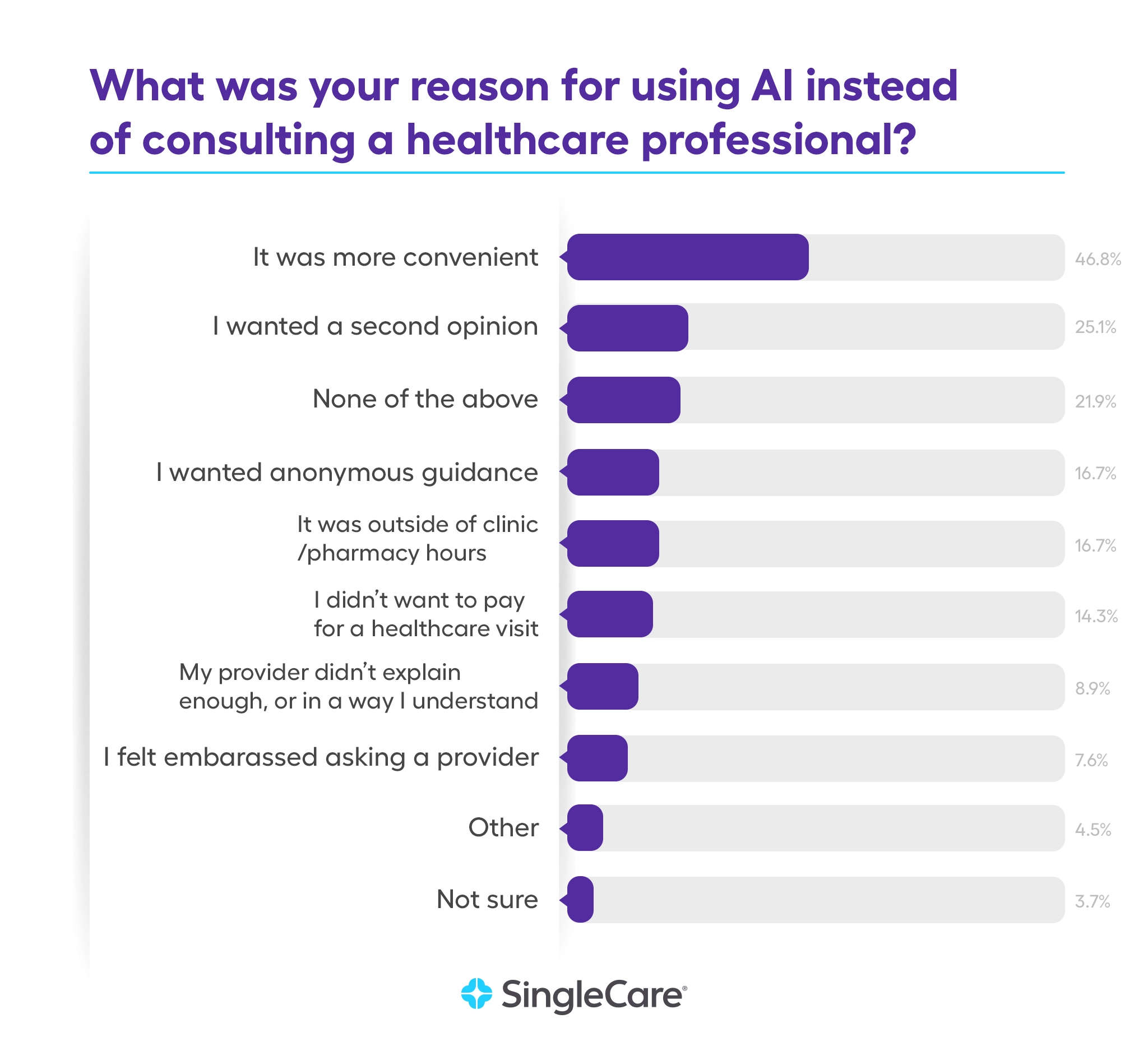
Convenience was the main driver of AI use for medication research:
- 47% said AI is more convenient
- 25% wanted a second opinion
- 17% wanted anonymous guidance
- 17% used it outside of office hours
- 14% wanted to avoid paying for a visit
- 9% felt their provider didn’t explain enough or in a way they understood
- 8% felt embarrassed asking a provider
Additionally, 30% said they felt more comfortable asking AI-sensitive health questions, while 38% said it depended on the topic.
People trust AI but still verify responses
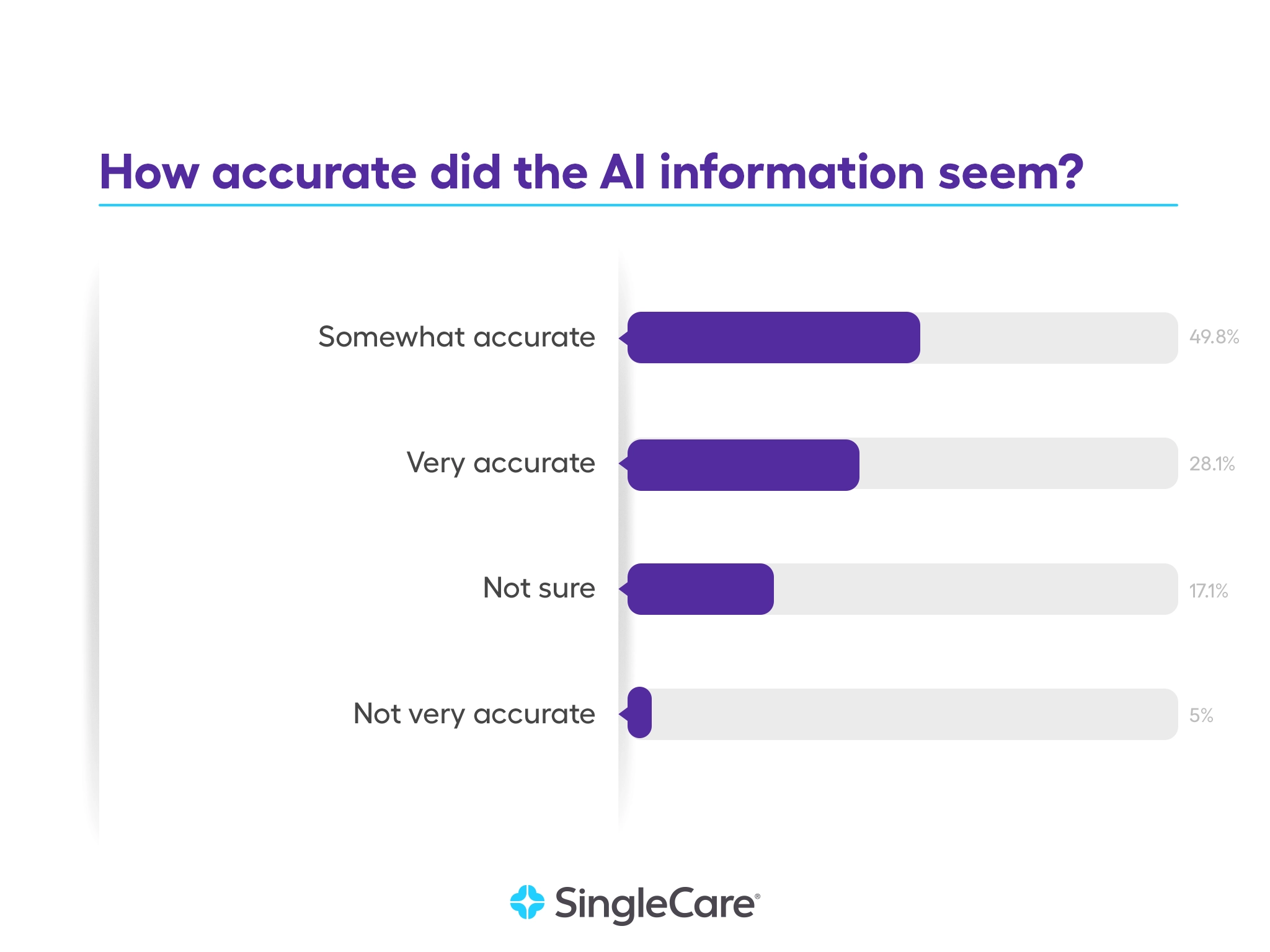
Most users viewed AI as accurate, but still took steps to verify the information:
- 78% thought AI information was at least somewhat accurate
- 17% were unsure whether AI information was accurate
- 5% thought AI information was inaccurate
Although many reported that AI-generated information appeared accurate, most (68%) still verified it: 35% verified sources, and 33% checked with a healthcare provider. About a third (32%) didn’t take any steps to check that what AI said was true.
“I don’t think AI does a perfect job at giving the most up-to-date and accurate information,” says Gerardo Sison, Pharm.D. “What could be dangerous is that they’re pulling from inaccurate sources. I think AI could be helpful for guiding you in the right direction for general health info, but for deeper issues, I’d always say see a doctor or pharmacist.”
A 2024 study checked the completeness and accuracy of ChatGPT’s responses to medication questions and found that ChatGPT did not provide sources in most cases, and of the responses that contained sources, each had at least one fabricated source. A separate 2025 study found that AI accuracy pertaining to medications was completely accurate only 19% of the time.
Concerns remain high
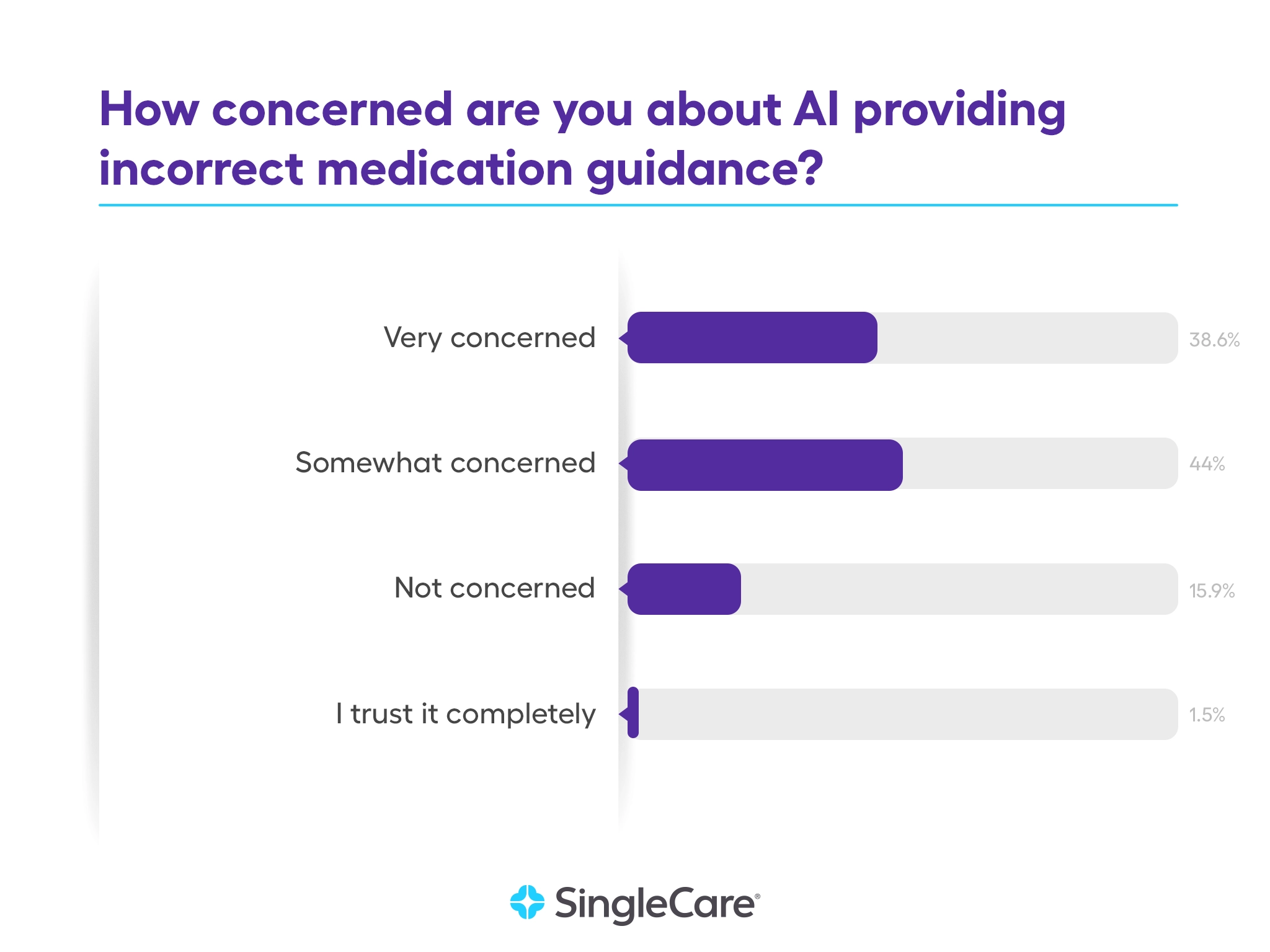
Despite growing use, concern about AI-generated information was widespread. The majority (83%) of survey respondents reported some degree of concern about AI providing incorrect medication guidance:
- 39% were very concerned
- 44% were somewhat concerned
- 16% were not concerned
- 1% trusted AI completely
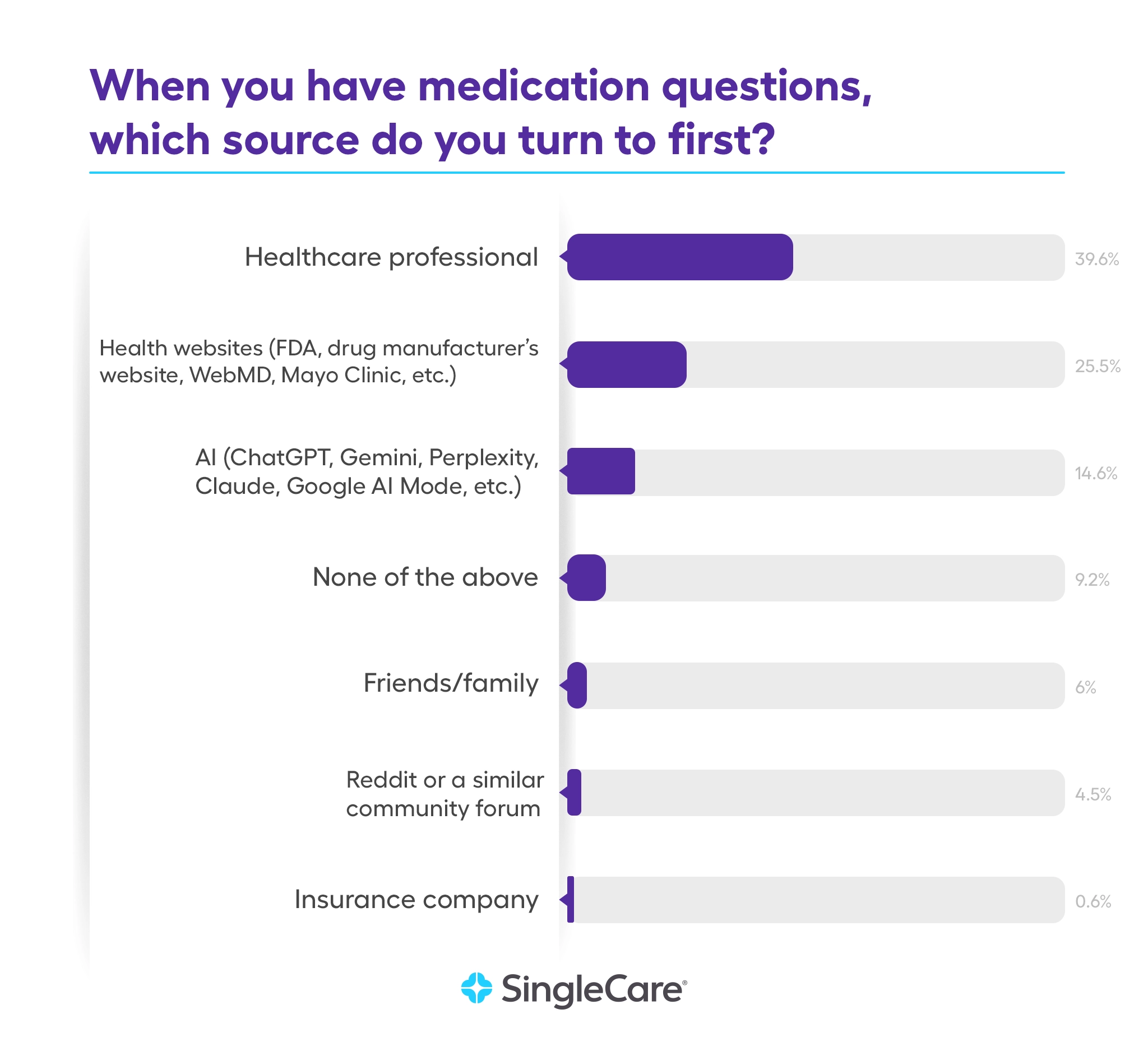
Healthcare professionals remained the top source for medication questions (40%), followed by health websites (26%) and AI (15%).
AI in healthcare is still mostly invisible to patients
Many new AI health tools are coming to market for professionals. SingleCare’s Medical Review Board members reported using AI in the following ways:
- Medication research
- Insurance coverage details
- Drafting prior authorization letters
- Assistance with documentation
- Generating summaries of patients’ health histories
A survey by the American Medical Association found that two-thirds of physicians are using AI for certain healthcare tasks; however, our survey showed that these tools aren’t yet apparent to patients. Only 16% reported having seen AI used in their healthcare settings. This would make sense, as many of the ways AI is described as being used in clinical settings were behind-the-scenes tools used outside of appointment times.
Survey methodology
SingleCare conducted this AI and Medication Survey online through AYTM on March 13, 2026. This national survey includes 1,000 United States adults ages 18 and older. Participant samples were census-balanced to match the U.S. population in age, gender, and U.S. region. The AI examples we gave to surveytakers included ChatGPT, Gemini, Perplexity, Claude, and Google AI Mode. Unless otherwise noted, all survey statistics in this article are from SingleCare’s 2026 AI and Medication Survey.
- SingleCare AI and Medication Survey, Original research; survey of 1,000 U.S. adults conducted via AYTM on March 13, 2026
- Appropriateness of ChatGPT as a resource for medication-related questions, British Journal of Clinical Pharmacology (2024)
- Artificial intelligence for drug information: Evaluating its use in real-world pharmacy practice, American Journal of Health-System Pharmacy (2025)
- 2 in 3 physicians were using health AI – up 78% from 2023, American Medical Association (2025)
- Medically accurate: SingleCare’s Medical Review Board analyzes all of our content to confirm it’s in line with current medical advice.
- Evidence-based: Our content is sourced from reputable U.S.-based healthcare professionals and peer-reviewed research.
- Trustworthy: All of SingleCare’s content goes through a multi-phase review process by our writers, editors, and Medical Board in order to provide clear and credible information.