





Key takeaways
Ozempic requires gradual dose increases to minimize side effects and needs to be taken on the same day each week.
Patients taking Ozempic need to rotate their injection sites in order to prevent skin irritation or infection.
Using an Ozempic dosage chart to log your doses and injection sites makes it easier to follow your treatment plan.


Ozempic (semaglutide) is a prescription medication approved to treat Type 2 diabetes. The medication is available as an injection or oral tablet. Both forms are also approved by the Food and Drug Administration (FDA) to reduce the risk of adverse cardiovascular events in adults with Type 2 diabetes and heart disease. Additionally, the injection is FDA approved to reduce worsening of kidney disease in adults with Type 2 diabetes and chronic kidney disease.
Ozempic is a glucagon-like peptide-1 (GLP-1) receptor agonist, which works by mimicking a hormone called GLP-1 to help lower blood sugar levels in the body. Since it also reduces appetite and calorie intake, it is commonly prescribed off-label to achieve weight loss.
Healthcare providers determine what dosage of Ozempic to prescribe based on which condition it is intended to treat, the patient’s treatment goals, and how well the patient is responding to the medication. Because both formulations of Ozempic require titration (increasing dosage over time), having a chart to track your dosage can be convenient.
Save up to 80% on Ozempic with SingleCare
Different pharmacies offer different prices for the same medication. SingleCare helps find the best price for you.


Ozempic dosage
The recommended starting dose of injectable Ozempic is 0.25 milligrams (mg) administered subcutaneously (under the skin) once a week for the first four weeks. The dosage can then be increased to the standard dosage of 0.5 mg once weekly. A gradual increase in dosage helps the body adjust to the medication and reduces the risk of side effects.
If blood sugar levels in Type 2 diabetes patients remain uncontrolled at 0.5 mg per week for four weeks, their healthcare provider may increase the dosage to 1 mg once weekly. The same is true for patients with chronic kidney disease. After four weeks on the 1 mg dose, the dosage may be increased to 2 mg if needed for further glycemic control in patients with Type 2 diabetes. The maximum dose should not exceed 2 mg once per week.
Oral Ozempic also requires dose titration starting at an initial dose of 1.5 mg once daily for 30 days, then increasing to 4 mg once daily for 30 days. If glycemic goals are not achieved at this dose, the dose can be increased and capped at the maximum dosage of 9 mg once daily thereafter.
Adjustments in dosage may be needed based on blood sugar levels, including your A1C levels. The A1C level shows your average blood sugar level over the past 2–3 months (about 90 days). Your healthcare provider may recommend regular lab visits to monitor your condition.
Below is an overview of what an initial Ozempic dosing schedule might look like. Your healthcare provider will prescribe a dosing schedule that’s right for you. Always follow your healthcare provider’s guidance. Never change your dosage without consulting them first.
Ozempic dosage
The recommended starting dose of injectable Ozempic is 0.25 milligrams (mg) administered subcutaneously (under the skin) once a week for the first four weeks. The dosage can then be increased to the standard dosage of 0.5 mg once weekly. A gradual increase in dosage helps the body adjust to the medication and reduces the risk of side effects.
If blood sugar levels in Type 2 diabetes patients remain uncontrolled at 0.5 mg per week for four weeks, their healthcare provider may increase the dosage to 1 mg once weekly. The same is true for patients with chronic kidney disease. After four weeks on the 1 mg dose, the dosage may be increased to 2 mg if needed for further glycemic control in patients with Type 2 diabetes. The maximum dose should not exceed 2 mg once per week.
Oral Ozempic also requires dose titration starting at an initial dose of 1.5 mg once daily for 30 days, then increasing to 4 mg once daily for 30 days. If glycemic goals are not achieved at this dose, the dose can be increased and capped at the maximum dosage of 9 mg once daily thereafter.
Adjustments in dosage may be needed based on blood sugar levels, including your A1C levels. The A1C level shows your average blood sugar level over the past 2–3 months (about 90 days). Your healthcare provider may recommend regular lab visits to monitor your condition.
Below is an overview of what an initial Ozempic dosing schedule might look like. Your healthcare provider will prescribe a dosing schedule that’s right for you. Always follow your healthcare provider’s guidance. Never change your dosage without consulting them first.
Ozempic dosage chart |
||||
|---|---|---|---|---|
| Month | Injectable Dose | Injectable Frequency | Oral Dose | Oral Frequency |
| Month 1 | 0.25 mg | Once per week | 1.5 mg | Once daily |
| Month 2 | 0.5 mg | Once per week | 4 mg | Once daily |
| Month 3 | 1 mg | Once per week | 9 mg | Once daily |
| Month 4 and beyond | 2 mg | Once per week | 9 mg | |
Ozempic dosage for weight loss vs. diabetes
The above dosages are FDA approved for type 2 diabetes management. If an individual has Type 2 diabetes and is overweight or has obesity, the dosage may be the same. If a healthcare provider prescribes Ozempic off-label solely for weight loss, they may or may not recommend a different dosing schedule.
In any case, there’s no standard Ozempic dosage for weight loss since the drug is not FDA approved for this purpose. For weight loss alone, a healthcare provider may recommend Wegovy, which contains the same active ingredient (semaglutide) as Ozempic but is specifically FDA approved for weight loss. Wegovy pens come in different strengths than Ozempic. While the initial starting dosage of Wegovy is 0.25 mg once weekly for four weeks, the target dosage is 1.7 mg or 2.4 mg once weekly. Wegovy oral tablets are dosed similarly to Ozempic, but at month 4 and beyond the dose can be further increased and capped at 25 mg once daily.
RELATED: Wegovy vs. Ozempic
How to take Ozempic
Ozempic tablets should be taken in the morning with up to 4 ounces of plain water at least 30 minutes prior to eating food, drinking beverages, or taking other oral medications. Tablets should be swallowed whole. They should not be split, crushed, or chewed.
Injectable Ozempic is typically administered under the skin once weekly with or without food at any time of day. Doctors and healthcare providers recommend that patients take the drug on the same day each week..
You can inject Ozempic under the skin of the abdominal area (at least 2 inches from your belly button), thigh, or upper arm. It should not be injected into the muscle or vein. Avoid injecting the medication in the same spot for each dose. Instead, you should rotate injection sites.
If you also take insulin, you can inject Ozempic and insulin in the same area of the body. However, avoid mixing insulin and Ozempic in the same injection.
You should also avoid sharing Ozempic pens with others, even if you’ve changed the needle. Sharing the pens carries a risk of spreading or getting a serious infection, like cellulitis, hepatitis, or HIV.
What to do if you miss a dose of Ozempic
For a missed dose of oral Ozempic, FDA labeling instructs patients to skip the missed dose and take the next scheduled dose the following day. Two tablets should not be taken together to make up for a mixed dose, and no dose reduction or re-titration is needed after missed doses due to the medication’s long half-life.
Missing a dose of injectable Ozempic is possible, especially since its once-weekly dosing schedule can make it easy to forget. Here’s what to do if you miss a dose:
- If you forget to take your Ozempic dose and your next dose is over 48 hours away, inject the missed dose as soon as you remember.
- If your next dose is due in less than 48 hours, simply wait and continue your regular dosing schedule on the usual day.
- If you skip two or more doses in a row, you can either return to your regular dosing routine , or restart Ozempic with the initial dose escalation. Starting at low doses and gradually increasing the dose helps reduce potential gastrointestinal discomfort after restarting treatment. Always seek guidance from your healthcare before making dosage adjustments.
Other considerations to keep in mind with injectable Ozempic include:
- Do not take two doses of Ozempic within 48 hours of each other. Doing so may carry a potential risk of overdose and serious side effects.
- It may be helpful to set reminders or alerts to maintain the dosing schedule and prevent missed doses.
Keeping a weekly Ozempic dose and injection site log can help you keep track of your doses and ensure you rotate injection sites.
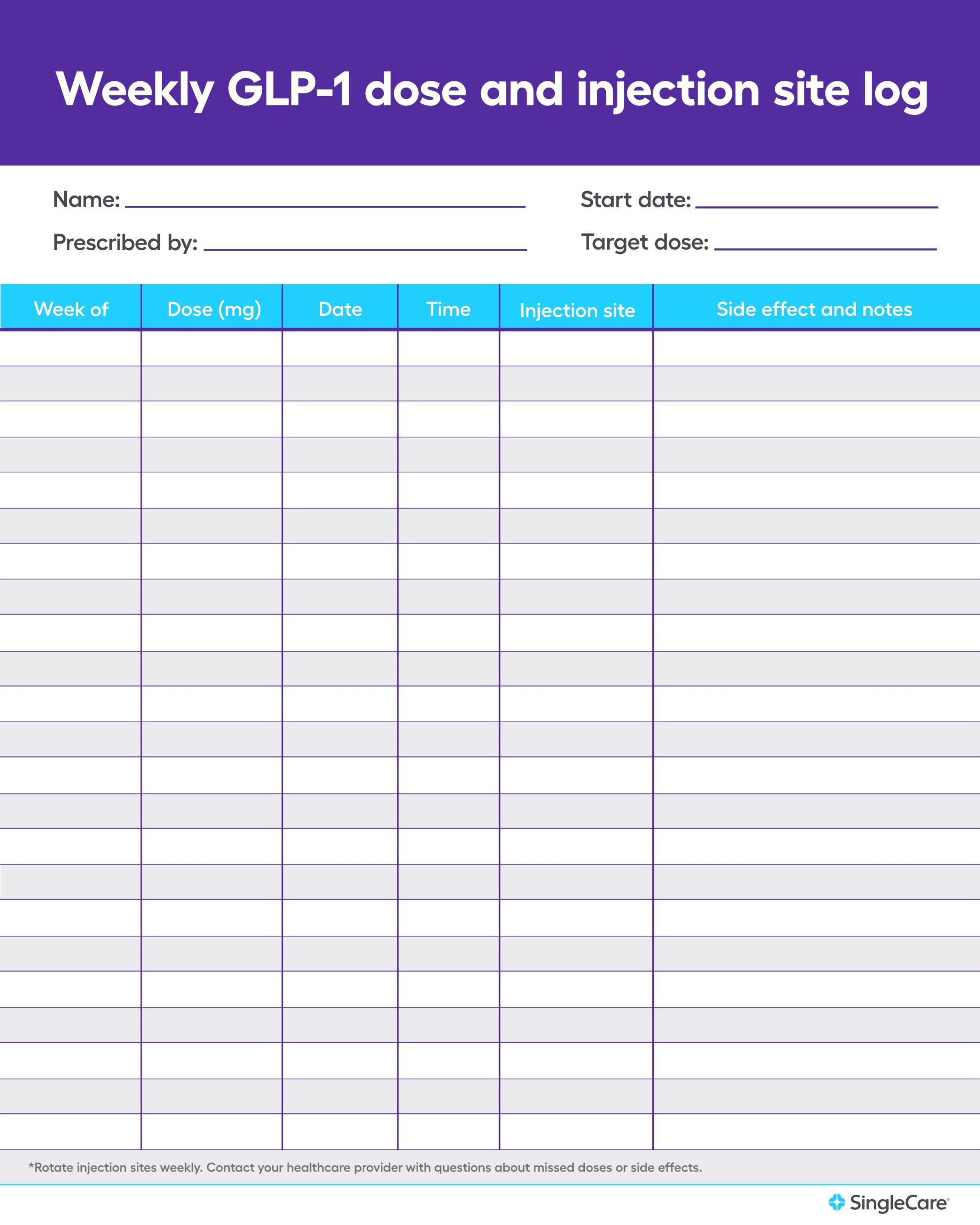
DOWNLOAD THIS GLP-1 DOSAGE CHART FOR FREE
In most cases, missing a dose is not a serious concern. If you habitually miss doses, consult a healthcare provider to determine whether a different medication is necessary. Ozempic tablets are a good alternative for those who prefer a once-daily oral medication.
Now that you have a resource to track your treatment, here’s how to make it more affordable.
Frequently asked questions
What is the starting dose of Ozempic?
The starting dose of Ozempic tablets is 1.5 mg orally once daily, while the starting dose of injectable Ozempic is 0.25 mg subcutaneously once weekly.
What is the highest dose of Ozempic?
The highest dose of Ozempic tablets is 9 mg orally once daily, while the maximum dose of injectable Ozempic is 2 mg subcutaneously once weekly.
How many doses come in one Ozempic pen?
There are four doses in an Ozempic pen, regardless of dosage. The manufacturer, Novo Nordisk, does not recommend splitting doses.
Can you split an Ozempic dose or take it twice a week?
The efficacy or safety of splitting a weekly dose into twice weekly injections has not been established.The prescribing label instructs dosing once weekly on the same day.
What should you expect after your first dose of Ozempic?
The onset of glucose-lowering effect occurs within the first 4 to 8 weeks of treatment. Adverse side effects, like nausea, vomiting, diarrhea, or constipation may be experienced shortly after the first dose and with dosage escalations..
The SingleCare prices in this article are the most accurate at the time of publishing in ZIP code 23666 as of Aug. 31, 2026. Prices vary by pharmacy. Visit our coupon page for updated drug prices at pharmacies near you.
- Semaglutide and cardiovascular outcomes in patients with type 2 diabetes, New England Journal of Medicine (2016)
- Ozempic drug label information, DailyMed (2025)
- Can you overdose on Ozempic for weight loss?, Missouri Poison Center (2023)
- Medically accurate: SingleCare’s Medical Review Board analyzes all of our content to confirm it’s in line with current medical advice.
- Evidence-based: Our content is sourced from reputable U.S.-based healthcare professionals and peer-reviewed research.
- Trustworthy: All of SingleCare’s content goes through a multi-phase review process by our writers, editors, and Medical Board in order to provide clear and credible information.