




 Search for articles or Rx savings


Key takeaways
Mixing clonazepam and even small amounts of alcohol can cause increased drowsiness, dizziness, confusion, and respiratory depression.
Older adults or people with liver, kidney, or lung problems may have higher risks of side effects from combining the two.
It stays in your body longer than you think. Wait at least a week after your last dose before having a cocktail.


Clonazepam, also sold under the brand name Klonopin, is a prescription drug that is FDA approved to help people manage seizures and mental health disorders, such as panic disorder or panic attacks. It calms the central nervous system (CNS) and can help make daily life easier to manage. However, mixing it with certain substances, especially alcohol, may lead to serious health risks, including abnormal blood pressure, heart rate, and breathing. In severe cases, mixing clonazepam and alcohol could lead to passing out or even death from an overdose. It’s also a Schedule IV controlled substance that comes with a risk of physical dependence and substance abuse.
Can you drink while taking clonazepam?
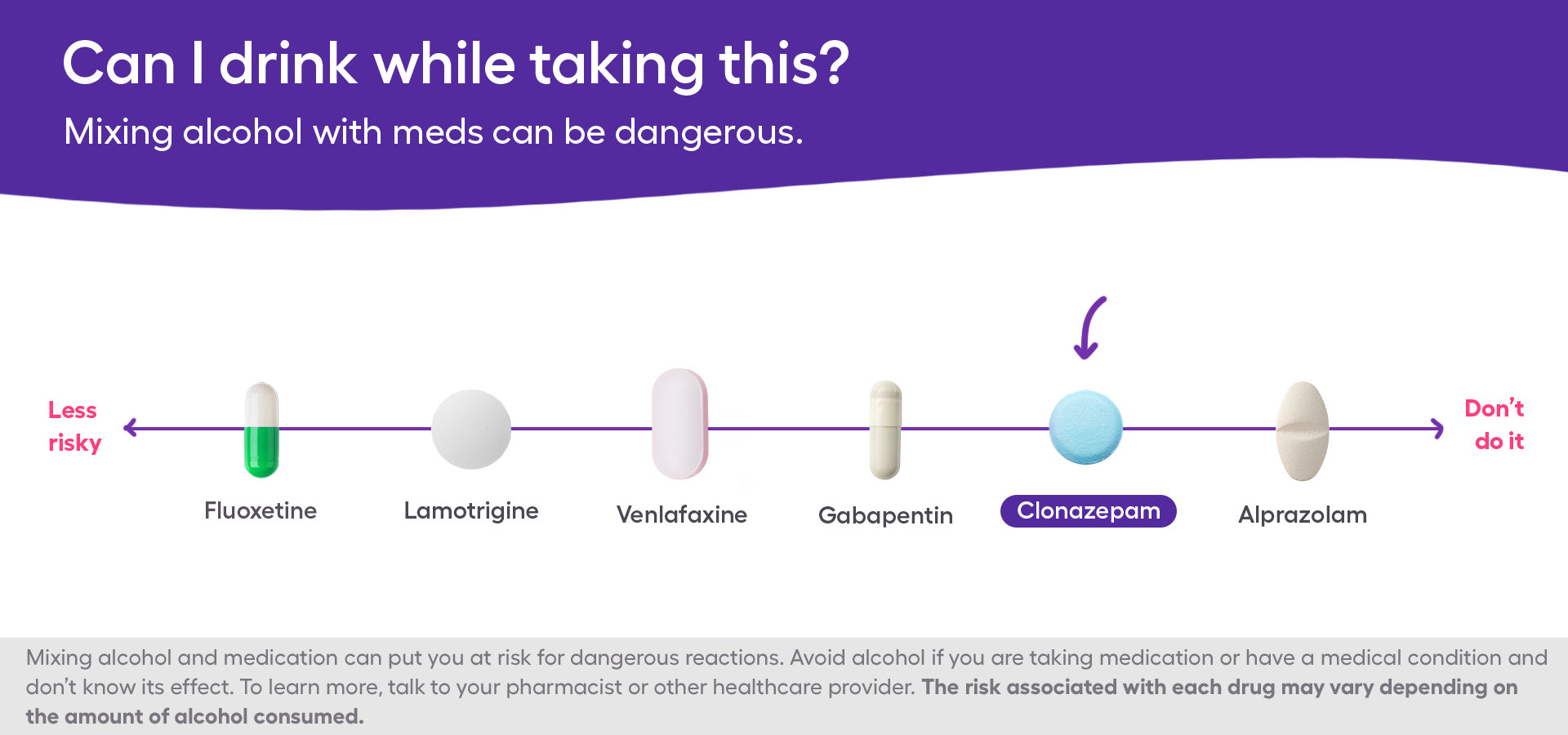
No, you shouldn’t drink alcohol while taking clonazepam. Mixing alcohol and clonazepam can be dangerous since they both slow the nervous system. Clonazepam is a CNS depressant that increases the effects of GABA, a chemical that calms activity in the brain. It can cause drowsiness, dizziness, and other side effects. Even a small amount of alcohol can compound the effects of Klonopin exponentially.
Although some people might think that moderate drinking is harmless with clonazepam, that’s not true. Moderate drinking, or one drink per day for women and two drinks per day for men, can still lead to increased side effects of clonazepam. The interaction between ethanol and clonazepam can happen at any level, and the effects can sneak up fast, which is why healthcare providers suggest avoiding it.
Benzodiazepines like clonazepam may sometimes be used for those who are coming off heavy alcohol use. In medical detox treatment programs, clonazepam can help manage withdrawal symptoms like anxiety, restlessness, and cravings. However, because mixing the two is still dangerous, this type of treatment is often started in an inpatient or rehab center.
Save up to 80% on Clonazepam with SingleCare
Different pharmacies offer different prices for the same medication. SingleCare helps find the best price for you.


What happens if you mix clonazepam and alcohol?
Mixing clonazepam with alcohol can come with a number of different effects. These effects can often be severe, no matter the dosage.
Extreme drowsiness
Drowsiness is one of the most notorious side effects of benzodiazepines like clonazepam. Many people find themselves more tired or sleepy than usual after taking a dose. Alcohol can amplify this side effect, sometimes causing people to nod off without warning. After mixing the two substances, people might experience a sleepy, groggy feeling that lasts for hours even after waking up.
Increased chance of seizures
Clonazepam may be prescribed to help prevent seizures. However, alcohol can lower the seizure threshold, potentially counteracting the effects of the medication. The risk of seizures may be higher in people who are going through alcohol withdrawal. In rare cases, people without a history of seizures could potentially experience one after mixing Klonopin and alcohol.
Dizziness and impaired coordination
Dizziness and impaired coordination are other common side effects of clonazepam. After drinking alcohol with clonazepam, “the spins” can be even more severe and disorienting. It might be hard to stand, balance, or walk in a straight line. Slurred speech and delayed reaction times can stick around for hours after drinking and taking clonazepam.
Slowed breathing
Respiratory depression is one of the most dangerous risks of mixing clonazepam and alcohol. Clonazepam can already slow breathing and heart rate on its own. Adding alcohol could slow breathing so much that it causes fainting or worse. Someone who is struggling to breathe after mixing the two needs immediate medical attention.
Confusion and memory problems
Amnesia or memory loss is a potential side effect of clonazepam. Mixing alcohol and clonazepam could worsen short-term memory loss. It may be easier to black out while mixing the two. Some people might have whole conversations or do things they can’t remember the next day. Over time, consistently mixing the two could lead to more serious cognitive problems with learning and critical thinking.
Increased risk of overdose, dependence, or withdrawal
Mixing alcohol and clonazepam may increase the risk of an overdose, since they can both disrupt a person’s sense of judgment. The risk of an overdose may be higher in someone with alcohol addiction or alcohol use disorder. Alcohol withdrawal symptoms could lead to worsened seizures, anxiety, or even mental health problems like suicidal thoughts, which may be amplified by taking clonazepam.
Not everyone reacts the same to alcohol or clonazepam. That’s why some people may experience more severe effects than others.
Are certain people at greater risk of side effects?
Some individuals may be more susceptible to severe side effects than others. That’s because of how clonazepam is processed in the body. Age and certain health conditions can also play a role.
People with liver or kidney problems
Clonazepam and alcohol are mainly broken down in the liver, although they can also be filtered out by the kidneys. In people with kidney or liver problems, clonazepam and alcohol can build up in the body and cause more side effects. With higher levels of clonazepam and alcohol, a person might be more likely to experience severe drowsiness, respiratory depression, and even loss of consciousness.
Older adults
Adults 65 and older may not process substances as well as younger people due to aging. Aging may be linked to a higher risk of health conditions, including liver and kidney impairment. If they’re breaking down alcohol and clonazepam less efficiently, an older adult may experience more drowsiness, dizziness, memory problems, and other side effects. Drowsiness and dizziness could also lead to falls and serious injuries.
People with lung problems
For those with lung problems, such as chronic obstructive pulmonary disease (COPD) or asthma, mixing clonazepam and alcohol can slow breathing to dangerous levels. People with sleep apnea, in particular, could be at risk of respiratory depression while sleeping after mixing the two substances. Trouble breathing could be life-threatening, sometimes leading to coma or even death.
How long after taking clonazepam can you drink alcohol?
Clonazepam has a long half-life of around 30 to 40 hours, which means it can take that amount of time for half the drug to leave the body. However, it can remain in the body for over a week or more because it takes several half-lives to completely eliminate it.
Even when the effects of clonazepam wear off in six to 12 hours, the drug itself is still in the body. Drinking alcohol too soon could still lead to side effects like increased drowsiness or dizziness. Since the drug can last so long, the safest bet is to wait at least a week before drinking alcohol.
While it may be best to wait this amount of time before drinking, the effects of drinking after stopping clonazepam can vary, and not everyone reacts the same. Those who’ve been taking clonazepam daily at higher doses for a long time may take longer to get rid of the drug than those who’ve only been on a low dose for a short period.
Which anticonvulsants are not affected by alcohol?
Most anticonvulsants interact with alcohol to some degree. The reason can be found in how they work similarly to slow brain activity. After all, seizures and anxiety are often due to excess nerve activity. Mixing anticonvulsants with alcohol could lead to increased drowsiness and dizziness, among other CNS depressant effects.
Anticonvulsants that may interact with alcohol include:
- Neurontin (gabapentin)
- Lamictal (lamotrigine)
- Keppra (levetiracetam)
- Topamax (topiramate)
- Tegretol (carbamazepine)
- Depakote (divalproex sodium)
- Dilantin (phenytoin)
- Trileptal (oxcarbazepine)
While it’s not usually recommended to mix these prescription drugs with alcohol, a person’s reaction can depend on different factors. How a person handles the medication, how long they’ve been on it, and the amount of alcohol consumed can all have different effects.
Some people might tolerate alcohol better than others while on certain seizure meds. Those who are new to anticonvulsants usually experience more serious side effects from drinking alcohol during treatment.
The bottom line
Mixing clonazepam and alcohol is never safe, as both can slow brain activity and breathing. Older adults and those with liver, kidney, or breathing problems may be at higher risk of serious side effects, like drowsiness and dizziness. Combining the two also comes with an increased risk of substance use disorder, overdose, or other serious problems.
If you or a loved one is struggling with alcohol or prescription use, it’s best to consult a healthcare provider. Specific treatment options and alcohol rehab support may help with managing substance use disorders.
- Alcohol, MedlinePlus (2024)
- About moderate alcohol use, Centers for Disease Control and Prevention (2025)
- Alcohol withdrawal syndrome: Benzodiazepines and beyond, Journal of Clinical and Diagnostic Research (2015)
- Klonopin highlights of prescribing information, U.S. Food and Drug Administration (2023)
- Clonazepam, StatPearls (2023)
- Benzodiazepine-induced anterograde amnesia: Detrimental side effect to novel study tool, Frontiers in Pharmacology (2023)
- Alcohol withdrawal, MedlinePlus (2025)
- Clonazepam, Antiseizure Medication Interactions (2022)
- Aging and medications, MSD Manual (2025)
- Clonazepam, PubChem (2025)
- Tolerance to alcohol: A critical yet understudied factor in alcohol addiction, Pharmacology Biochemistry and Behavior (2022)