Vertigo symptoms: What are the early signs of vertigo?


Overview: What does vertigo feel like?
Vertigo is a type of dizziness where the world appears to be spinning, tilting, or swaying, even when standing completely still. In addition to the spinning, the eyes usually go back and forth like they’re trying to track the motion. People can feel off-balance and wobbly, walk differently, and fall. The spinning can cause motion sickness and nausea. It can even make people throw up if it lasts long enough. Vertigo has many causes, but all are centered on the inner ear or brain. The exact nature of the vertigo—how often it happens, when it happens, how long it lasts, how it’s triggered, how the eyes react, and associated symptoms—can often help a doctor discover the cause.
Key takeaways:
Vertigo is a common health condition that can affect anyone, regardless of age, sex, race, or ethnicity.
Early signs of vertigo include a spinning or moving sensation when standing still.
Serious symptoms, such as long-lasting vertigo, may require immediate medical attention.
Inner ear problems, infections, migraines, nerve problems, stroke, cancer, head injuries, or prescription drugs can cause vertigo. You may be at risk for developing vertigo symptoms if you are an older adult.
Vertigo requires a medical diagnosis.
Symptoms of vertigo generally do not require treatment unless episodes of vertigo are recurrent or long-lasting. Transient vertigo typically resolves without treatment within a few seconds, but vertigo episodes caused by some underlying conditions can last for hours, days, weeks, or months.
Treatment of vertigo may include prescription drugs, physical therapy, or lifestyle changes. Read more about vertigo treatments here.
Untreated vertigo could result in complications if serious medical conditions are not being treated. These include brain cancer, brain infections, inner ear cancer, and stroke.
Use coupons for meclizine, dimenhydrinate, metoclopramide, and diazepam to save up to 80%.
What are the early signs of vertigo?
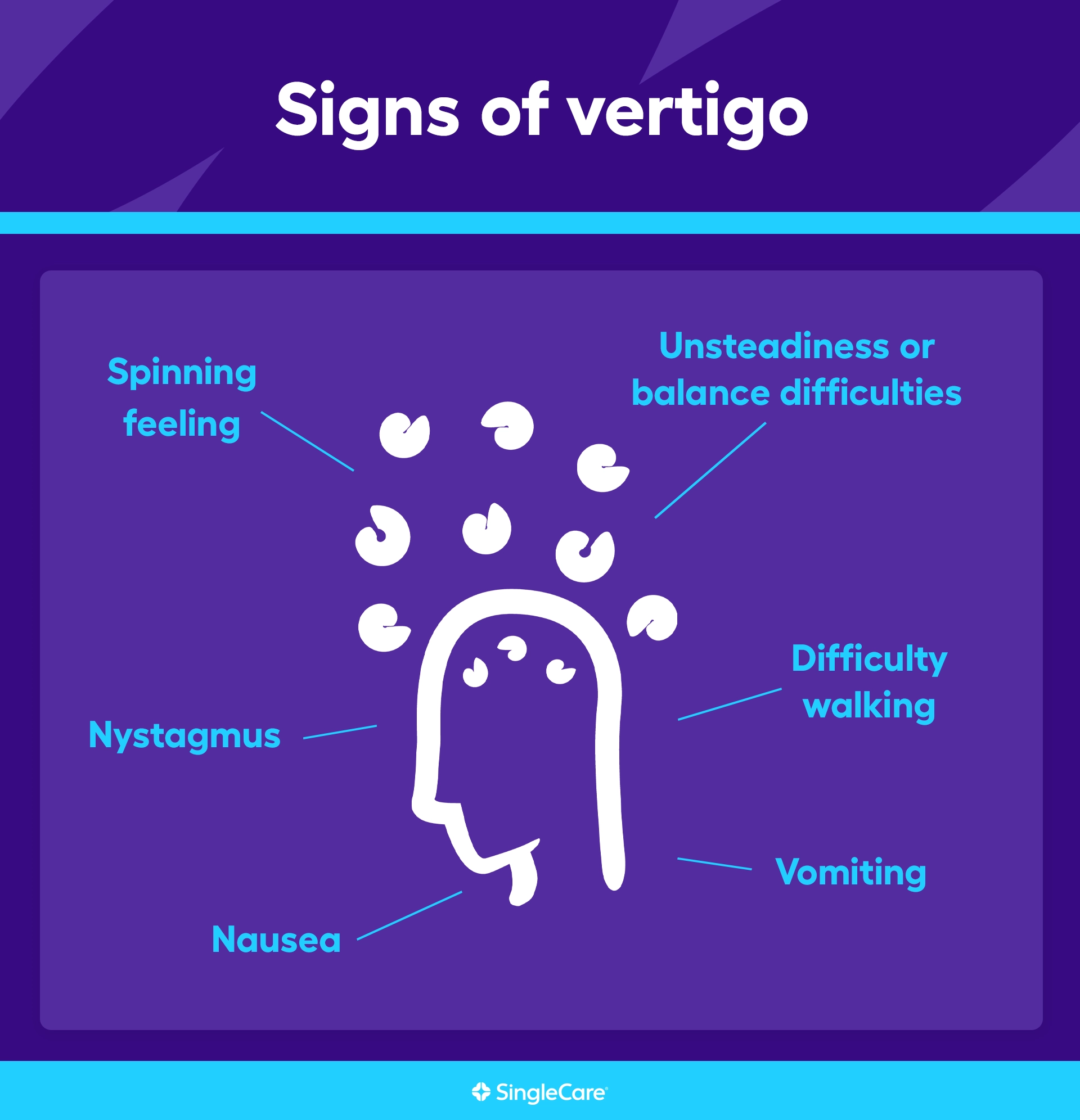
The core symptom of vertigo is:
A feeling that the world is moving even when standing still—this movement is typically a spinning feeling, but could also appear like the world is tilting or swaying
Other primary signs of vertigo are:
Unsteadiness or balance difficulties
Difficulty walking
Nystagmus—abnormal eye movements from side to side, up and down, or in circles as the eyes seem to be following a perceived movement
Nausea
Vomiting
RELATED: Going round and round: what it’s like experiencing vertigo
Secondary symptoms that may be related to the cause of vertigo include:
Ringing or buzzing in the ear (tinnitus)
Severe headache
Hearing loss
A “full feeling of sound” in one or both ears
Light sensitivity
Sound sensitivity
Types of dizziness: How can I tell which one I have?
Not everyone who thinks they’re dizzy is experiencing vertigo. Healthcare professionals distinguish between four types of dizziness: vertigo, disequilibrium, presyncope, and lightheadedness.
Vertigo is the feeling that the world is moving, usually spinning around, similar to coming off of a spinning ride. About half of the people who go to a healthcare professional with dizziness have vertigo.
Disequilibrium is a loss of balance. People feel wobbly, off-balance, and walk differently. They may fall. About 15% of people who complain of dizziness have a balance problem.
Presyncope is what people feel when they’re about to faint. They feel lightheaded and the world starts to go dark. They may also feel off-balance, fall, or lose consciousness. About 15% of people who say they feel dizzy are experiencing presyncope.
Lightheadedness is a less specific cluster of symptoms. It’s the same feeling you get if you breathe very fast for a while. The world doesn’t spin, but people feel like they’re floating, off-balance, or about to faint.
Types of vertigo: How can I tell which one I have?
Healthcare professionals distinguish between peripheral vertigo and central vertigo.
Problems in the inner ear cause peripheral vertigo. These problems are typically not very serious and account for about 80 to 90% of vertigo cases. Episodes can be severe, but they are often short-lived, usually only lasting seconds. Head movements often trigger them.
Problems in parts of the brain, such as the cerebellum, brainstem, and midbrain, cause central vertigo. These central nervous system problems can sometimes be serious or life-threatening, such as multiple sclerosis, stroke, or cancer. However, some causes of central vertigo are less serious, such as medication side effects or migraine headaches. Episodes of central vertigo typically last longer than peripheral vertigo episodes. Central vertigo episodes can sometimes last for days, weeks, or months.
When to see a doctor for vertigo symptoms
If vertigo happens just once or twice, then goes away, it is usually not something that should cause worry. If vertigo has an obvious cause, such as spinning around in circles or coming off of an amusement park ride, it is normal.
However, if vertigo happens regularly for no identifiable reason or for reasons that shouldn’t cause vertigo, like sitting up, then see a doctor. If vertigo doesn’t go away, immediate medical care may be needed.
A healthcare provider will first seek to determine if a patient is actually experiencing vertigo. The next step is determining if the vertigo is peripheral or central. The doctor will start with a medical history. The healthcare professional will want to know:
What does it feel like?
How often does it happen?
How long do episodes last?
Does anything trigger the dizziness?
Are there other symptoms?
What medications are being taken?
From there, the goal is to diagnose the underlying cause. This will start with a physical examination that includes neurological, head and neck and cardiovascular exams. Depending on the results, the doctor may order an MRI scan of the brain. A final diagnosis may require a specialist in neurology or otolaryngology.
Complications of vertigo
Since vertigo is only a symptom, the most significant complications involve untreated disorders causing vertigo. The most problematic disorders are:
Brain cancer
Inner ear tumor (acoustic neuroma)
Stroke
Infections
How to treat vertigo symptoms
Doctors will either treat the underlying cause of vertigo or try to relieve vertigo through drugs or physical therapy.
Three medical conditions are responsible for 93% of vertigo cases.
Benign paroxysmal positional vertigo (BPPV) is the most common cause of vertigo and primarily affects older adults. Free-floating calcium crystals cause BPPV in the semicircular canals, the part of the inner ear responsible for sensing motion and maintaining balance. When the head moves, the fluid in the canals sloshes around. Based on the fluid movement, the canals tell the brain what direction the head is moving. If there are free-floating crystals in the canals, they throw the mechanism off and cause vertigo whenever the head position is changed.
Meniere’s disease is when fluid builds up in the semicircular canals. Episodes of vertigo can last for hours, and people with Meniere’s will have other symptoms, such as tinnitus and hearing problems.
Acute vestibular neuritis (AVN) results from inflammation of the vestibular nerve, the nerve that connects the movement of sensory nerves in the semicircular canals to the brain.
Vertigo can also be caused by other vestibular disorders, inner ear infections (labyrinthitis), trauma, vestibular migraines, stroke, brain tumors, brain infections, multiple sclerosis, anxiety, alcohol abuse, and drugs.
People with BPPV, the mildest cause of vertigo, are usually treated by practicing head movements such as the Epley maneuver. Called canalith repositioning (CRP), these maneuvers move loose calcium crystals back to a place in the inner ear where they won’t cause vertigo.
The most common treatment options used to relieve vertigo include:
Prescription drugs, such as antihistamines, benzodiazepines, and antinausea drugs, to relieve long episodes of vertigo
Corticosteroids to reduce inner swelling that may be causing vertigo
Diuretics to reduce inner ear fluid buildup that may be causing vertigo
Physical therapy and vestibular rehabilitation for people with permanent inner ear problems
Lifestyle changes
RELATED: Vertigo treatments and medications
Living with vertigo
Episodes of vertigo may be a chronic or even lifelong problem in some people. Here are a few tips to prevent vertigo and minimize problems:
Take prescribed medications as instructed
Keep all medical and physical therapy appointments
Keep a symptoms journal to chronicle episodes, their duration, and triggers—share this journal with the doctor
Organize the home to avoid bending over or looking up
Manage or avoid stress
Get enough sleep
RELATED: Can stress cause vertigo?
Most importantly, see a doctor
If vertigo is happening over and over or if episodes of vertigo last for hours or longer, see a doctor. Do not try to self-diagnose. Vertigo episodes may be a sign of a serious problem that needs medical treatment. A healthcare professional can assess vertigo symptoms and arrive at an accurate diagnosis of the underlying problem.
FAQs about vertigo symptoms
What does vertigo feel like?
Vertigo feels like you’re moving, or the world is moving, but you’re standing still. It’s what most people mean when they say they’re dizzy. Most of us have experienced vertigo, usually after spinning around, running in tight circles, or coming off of an amusement park ride.
How long does vertigo last?
If there’s no medical problem or a benign inner ear disorder, vertigo gradually improves and goes away in a few seconds. If it’s caused by a serious medical problem, such as inner ear infections, ear tumors, brain tumors, fluid buildup, or stroke, vertigo episodes may last for hours, days, weeks, or months.
How can I tell which ear is causing vertigo?
People with benign paroxysmal positional vertigo get dizzy when they move their heads. This is due to calcium crystals floating loose in one or both ear canals. It is possible to see if one or both ears are causing the problem.
Sit upright on a bed
Turn the head to the right or left
Focus the eyes on one object
Sit in that position for about 45 seconds
Lie down with the head still turned
In a few seconds, you should feel vertigo if that ear is the problem
Now do the same on the other side
What’s next? Additional resources for people with vertigo symptoms
Test and diagnostics
Initial evaluation of vertigo, American Family Physician
Vertigo, StatPearls
Treatments
Home Epley maneuver, Johns Hopkins Medicine
Treatment of vertigo, American Family Physician
Vertigo treatments and medications, SingleCare
Scientific studies and clinical trials
Benign paroxysmal positional vertigo, Laryngoscope Investigative Otolaryngology
Review of the pathology underlying benign paroxysmal positional vertigo, Journal of International Medical Research
More information on related health conditions
Anxiety treatments and medications, SingleCare
Dizziness: a diagnostic approach, American Family Physician
Meniere’s disease treatments and medications, SingleCare
Migraine medications and treatments, SingleCare
Subscribe to our savings newsletter
Health education, drug info, wellness & more
By clicking 'Subscribe', I agree to SingleCare's Terms & Conditions.








