




 Search for articles or Rx savings



Key takeaways
Mixing Prozac and alcohol can be risky and is not generally recommended.
The combination may cause drowsiness, worsen depression, and increase the risk of seizures, among other side effects.
The safest option is to avoid alcohol while on Prozac, since even small amounts can cause unpredictable effects.


Prozac (fluoxetine) is a brand-name prescription used to manage certain mental health conditions such as depression, obsessive-compulsive disorder (OCD), bulimia nervosa, and panic disorder. It belongs to a group of antidepressants called selective serotonin reuptake inhibitors (SSRIs), which work by balancing certain neurotransmitters involved in mood and well-being. Usually, it’s taken once daily, in the morning.
While it’s typically recommended to avoid drinking alcohol on Prozac, life happens, and, for some people who’ve been on the drug long-term with no complications, one drink is unlikely to cause serious harm. Still, mixing Prozac and alcohol can cause potential side effects, some of which can be severe, and even worsen depression or anxiety.
Save up to 80% on Fluoxetine with SingleCare
Different pharmacies offer different prices for the same medication. SingleCare helps find the best price for you.


Can you drink while taking Prozac?
Short answer: Most healthcare providers don’t recommend mixing alcohol and Prozac. The drug’s FDA label also recommends against drinking alcohol while on Prozac. The effects of mixing the two may be more severe when first starting treatment.
Everyone is different in how they respond to medication or tolerate alcohol. Even a single drink could cause severe side effects for some taking Prozac. However, your healthcare providers may give the go-ahead for an occasional drink if you have been taking the drug for a while and understand how it affects you.
In some cases, Prozac may be prescribed off-label for people with alcohol use disorder. Research shows that fluoxetine decreases alcohol intake and the desire to drink in some patients. Because of this effect, providers may prescribe it during alcohol withdrawal to reduce cravings.
What happens if you mix Prozac and alcohol?
Mixing Prozac and alcohol can be a recipe for serious side effects. This interaction can affect the mind and body in different ways, with some people experiencing drowsiness, worsened mental health symptoms, and other problems.
Increased drowsiness and impaired coordination
As both substances can affect brain activity, mixing alcohol with Prozac can quickly lead to increased drowsiness and impaired motor skills. A person who mixes the two might find it hard to walk straight, drive, or operate machinery. On top of that, alcohol can make it harder to think clearly, so your decision-making may not be as sharp as usual.
Worsened depression or suicidal thoughts in young adults
Alcohol acts as a depressant on the brain. As a result, it can blunt the benefits of Prozac and potentially worsen symptoms of depression. In severe cases, drinking large amounts of alcohol over time while taking Prozac could trigger suicidal thoughts or behaviors. Taken on its own, Prozac carries a risk of suicidal thoughts, especially in young adults. Mixed with alcohol, the risk of these negative effects can increase.
Higher risk of serotonin syndrome
Serotonin syndrome occurs when too much serotonin builds up in the brain. As an SSRI, Prozac helps treat depression by increasing serotonin levels. Drinking large amounts of alcohol in a short amount of time is also known to increase serotonin. Doing so after taking Prozac could increase the risk of serotonin syndrome, potentially leading to life-threatening symptoms, such as fever, high blood pressure, and muscle spasms.
Increased risk of seizures
Both Prozac and alcohol can lower the seizure threshold. Putting them together could mean an increased risk of seizures, even in those who’ve never had a seizure before. Alcohol typically doesn’t trigger seizures while actively drinking, but withdrawal-related seizures can happen six to 72 hours after drinking.
Added stress on the liver
The liver has a role in breaking down both Prozac and alcohol. Heavy alcohol consumption is linked to fatty liver, hepatitis, and even cirrhosis. Because Prozac is also processed in the liver, a liver that isn’t working well won’t clear the medication the way it should. This can cause Prozac to build up in the body and increase the risk of adverse effects.
Higher bleeding risks
Prozac can interfere with blood clotting and should be used with caution while taking warfarin or other blood thinners. Alcohol can decrease the function of platelets, also causing a blood-thinning effect. Mixing Prozac and alcohol could increase bleeding risks, especially in those taking blood thinners.
Are certain people at greater risk of side effects?
Mixing Prozac and alcohol can put you at risk for serious side effects. For those taking Prozac, it’s safest to limit or avoid alcohol and talk with a healthcare provider about drinking habits. Certain people may be at higher risk of experiencing side effects of Prozac and alcohol. Age and certain health conditions can make the combination more dangerous.
Older adults
Older adults process Prozac and alcohol more slowly than younger people, which means the effects can stick around for longer. In addition, older people often take multiple medications, which could interact with Prozac or alcohol. Since balance problems are more common in older people, they may be at a higher risk of falls and injuries while mixing Prozac with alcohol.
People with liver problems
The liver processes Prozac and alcohol. When the liver is damaged or not working well, Prozac may be metabolized more slowly, leading to increased drug levels. Those with liver problems typically need to take a lower dose of Prozac due to an increased risk of side effects.
How long after taking Prozac can you drink alcohol?
Prozac has a long half-life of up to four to six days, meaning it can take 20 to 30 days to fully clear from the body after your last dose. However, clearance time isn’t the same as safety.
Alcohol and Prozac can interact at any point, even if you don’t drink immediately after taking your medication. Drinking while on Prozac may increase side effects like drowsiness, poor coordination, or worsening mood symptoms.
Because Prozac remains in your system for a long period, most experts recommend avoiding alcohol altogether while taking it, and waiting at least two to four weeks after your final dose before drinking again. Always follow your provider’s guidance, as individual factors can change this timeline.
Are any antidepressants safe to mix with alcohol?
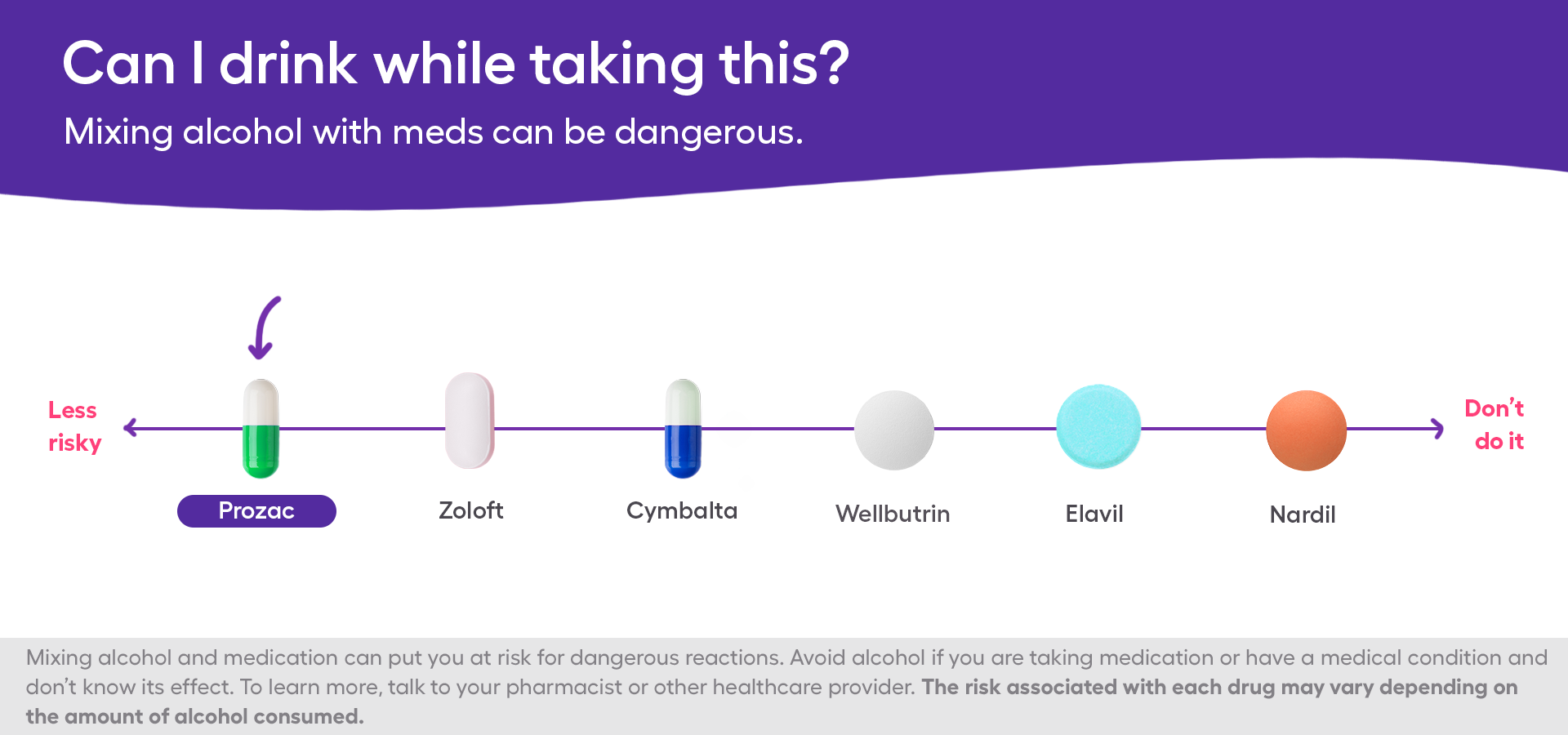
Most antidepressants don’t mix well with alcohol. There aren’t any that are completely safe to use with drinking. Even the ones that seem less risky can still cause harmful interactions while drinking.
The way alcohol affects antidepressants depends on several factors. How much someone drinks, how long they have been taking their medication, and how their body reacts can all play a part. For example, people who have just started taking an antidepressant may have more side effects with alcohol than those who’ve been on the same dose for months.
Other antidepressants that can interact with alcohol include:
- Serotonin-norepinephrine reuptake inhibitors (SNRIs), such as Cymbalta (duloxetine) and Effexor XR (venlafaxine)
- Tricyclic antidepressants (TCAs), such as Elavil (amitriptyline) and Pamelor (nortriptyline)
- Monoamine oxidase inhibitors (MAOIs), such as Nardil (phenelzine) and Parnate (tranylcypromine)
- Atypical antidepressants, such as Wellbutrin (bupropion) and Remeron (mirtazapine)
It’s best to avoid mixing an antidepressant medication with alcohol. As with Prozac, drinking alcohol with other antidepressants could lead to increased drowsiness, worsened symptoms of mental illness, and other problems.
Getting help for problems with alcohol use
For some people, drinking while on Prozac isn’t just a matter of one night out. It could mean bigger problems with alcohol abuse or substance use disorder. Alcohol addiction often goes hand in hand with mental health issues, and withdrawal symptoms can make it hard to stop drinking without help.
Treatment options usually start with detox, followed by alcohol abuse treatment programs that often entail behavioral therapy, counseling, and other forms of addiction treatment. These programs can help reduce cravings and look at the cause of problems with alcohol use. A healthcare provider may be able to connect you or a loved one to the right support.
The bottom line
It’s typically recommended to avoid drinking alcohol while taking Prozac, especially in those who are just starting the medication. Those who know how Prozac affects them and who don’t have other co-occurring disorders or medications may be able to drink an alcoholic beverage occasionally.
However, the FDA label recommends avoiding the mix altogether. Combining the two substances could lead to increased drowsiness, seizures, and, in severe cases, serotonin syndrome. Consult a healthcare provider for medical advice before drinking alcohol while on Prozac.
- Prozac highlights of prescribing information, U.S. Food and Drug Administration (2023)
- Fluoxetine attenuates alcohol intake and desire to drink, International Clinical Psychopharmacology (1994)
- Effects of alcohol intoxication on driving performance, confidence in driving ability, and psychomotor function: a randomized, double-blind, placebo-controlled study, Psychopharmacology (2022)
- A narrative review: Serotonin reuptake inhibitors and the risk of suicidal ideation in adolescents, Adolescents (2025)
- Alcohol and alcoholism associated neurological disorders: Current updates in a global perspective and recent recommendations, World Journal of Experimental Medicine (2025)
- Alcohol as a seizure trigger, Epilepsy Foundation (n.d.)
- Alcohol-associated liver disease: A review, Gastroenterology & Endoscopy (2025)
- Alcohol intake including wine drinking is associated with decreased platelet reactivity in a large population sample, International Journal of Epidemiology (2023)
- Fluoxetine, StatPearls (2024)
- Fluoxetine in the management of major depressive disorder in children and adolescents: A meta-analysis of randomized controlled trials, Hospital Pharmacy (2020)