Appendicitis symptoms: What are the early signs of appendicitis?



Overview: What does appendicitis feel like?
At first, appendicitis may feel like a sharp pain near the belly button that comes and goes. Eventually, it travels to the lower right side of the abdomen, where it becomes more constant and may be accompanied by nausea. Some people may experience pain in their lower back on the right side. Appendicitis pain may worsen when you cough, move, or press on the area. If the appendix ruptures, you may feel severe pain in the entire abdomen. This is a medical emergency.
Key takeaways:
Appendicitis is inflammation of the appendix, a small, thin tube attached to the large intestine in the lower-right corner of the abdomen.
Appendicitis may be caused by a blockage, such as stool, lymphoid swelling, or a tumor, in the lining of the appendix. The blockage is complicated by reduced blood flow and an influx of bacteria from the large intestine, which can cause infection.
Early signs of appendicitis include generalized pain around the belly button area that migrates to the lower right abdomen.
Appendicitis is a relatively common health condition that can affect anyone regardless of age, sex, race, or ethnicity, though it is slightly more common among men.
Symptoms of appendicitis generally require abdominal surgery, although intravenous antibiotics are sometimes tried. Read more about appendicitis treatments here.
Untreated appendicitis could result in life-threatening complications. Some complications include perforation of the appendix, infection of the abdominal cavity (peritonitis), and sepsis.
Save on prescriptions for appendicitis with a SingleCare prescription discount card.
What are the early signs of appendicitis?
The most common symptom and earliest sign of appendicitis is generalized pain centered around the navel. In the first hour or two, the pain may come and go a few times. As the appendix swells over the next few hours, the pain may move to the bottom right area of the abdomen and become constant. In some people, the appendix is located more toward the back of the pelvis, so they’re more likely to feel pain in the lower right side of the back. As the appendix swelling continues, coughing, a bumpy car ride, or walking may worsen the pain.
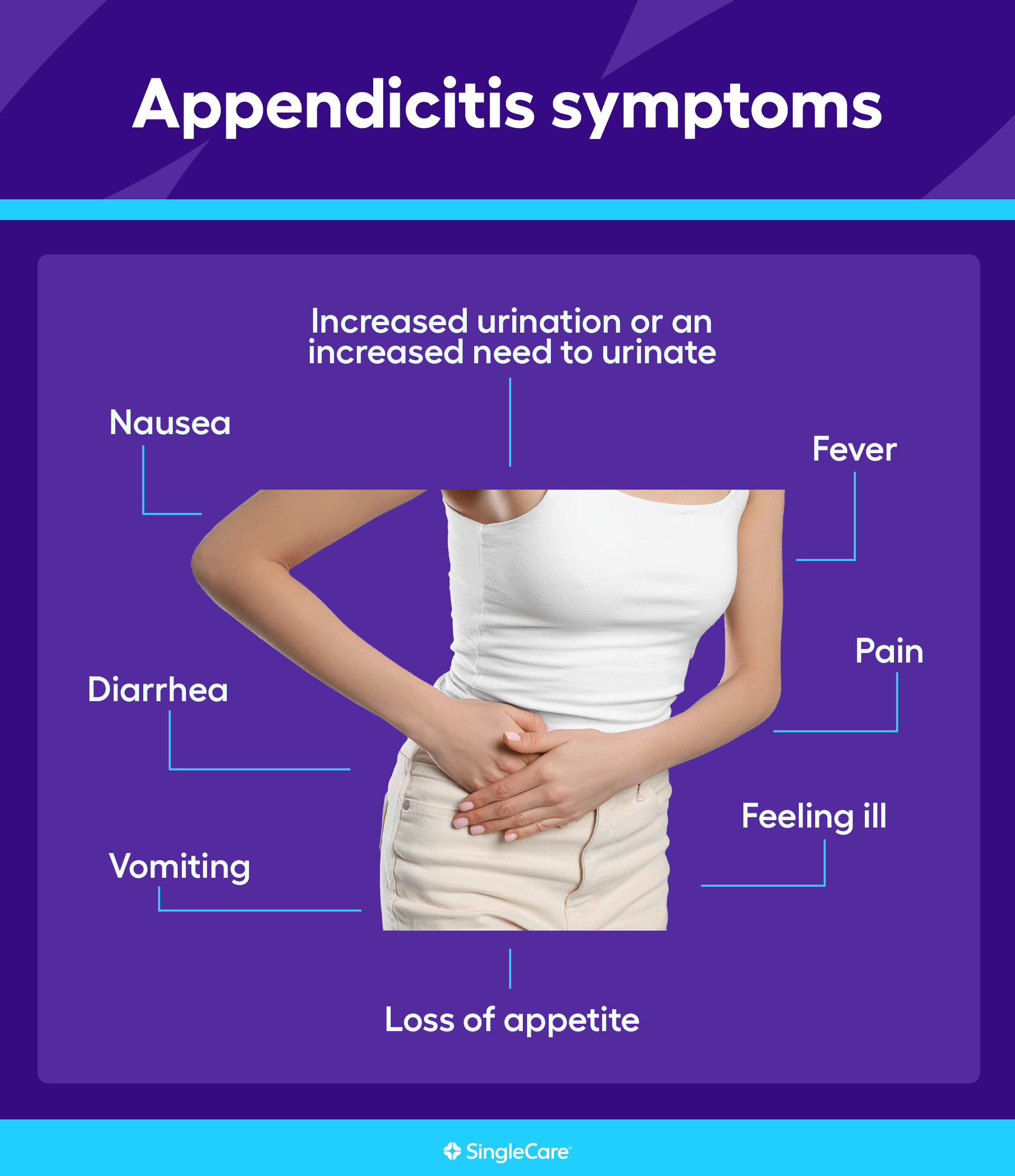
Other appendicitis symptoms
Other common symptoms of appendicitis include:
Fever
Nausea
Vomiting
Loss of appetite
Diarrhea
Feeling ill
Increased urination or an increased need to urinate
Overall, the classic appendicitis symptom complex of migratory pain, fever, nausea, vomiting, loss of appetite, and constipation only occurs in about half of patients with appendicitis. An individual with appendicitis may have any one of countless incomplete combinations of the symptoms.
Appendicitis symptoms in women
Women tend to have the same appendicitis symptoms as men. However, women with appendicitis may be more likely to be misdiagnosed with an incorrect diagnosis. A study published in the Journal of Emergency Medicine found that 33% of 174 nonpregnant women of childbearing age with appendicitis were initially misdiagnosed, often with pelvic inflammatory disease, gastroenteritis, or a urinary infection.
Appendicitis symptoms in kids
Depending on their age, children may or may not have the same appendicitis symptoms as adults. For example, children don’t commonly experience loss of appetite, vomiting, and nausea like adults with appendicitis do. And, although adults tend to experience pain when pressure is applied to the lower right abdomen, children are more likely to experience what’s called “rebound pain,” which occurs after pressure is removed from the area.
Appendicitis vs. ovarian cyst vs. kidney stone symptoms
Like appendicitis, ovarian cysts or kidney stones can cause abdominal pain. However, appendicitis requires emergency medical treatment, so it’s important to know how to recognize an inflamed appendix. Pain is the most obvious sign. Here’s how to differentiate appendicitis from kidney stones and ruptured ovarian cysts:
Appendicitis starts with pain around the belly button that soon moves to the lower right abdomen. At first, the pain comes and goes, but soon it becomes constant and unbearable. Other intestinal causes of pain include diverticulitis, infection, and Crohn’s disease.
Kidney stone pain starts near the upper abdomen or back, near the ribs, and can move down the abdomen. The pain is very sharp but usually comes in waves. Unlike appendicitis, moving does not usually affect the pain. Urinating is typically painful only when the stone has progressed farther along the urinary tract. Bloody urine may be experienced. Other urologic conditions can mimic appendicitis, too.
Pain due to a ruptured ovarian cyst can be in the lower right or left abdomen, but it does not typically start mid-abdomen. The pain may be sharp or dull and does not usually last. Ovarian abscess and torsion are two of the other gynecologic conditions with symptoms that are similar to appendicitis.
| Appendicitis vs. ovarian cyst vs. kidney stone | |||
|---|---|---|---|
| Appendicitis | Ovarian cyst | Kidney stone | |
| Shared symptoms |
|
||
| Unique symptoms |
|
|
|
Types of appendicitis
There are two main types of appendicitis: acute and chronic.
Acute appendicitis is what most people think of as appendicitis. It comes on suddenly and progresses rapidly. It’s usually divided into two stages: uncomplicated and complicated. When the only problem is an inflamed appendix, the situation is uncomplicated and can be resolved by removing the appendix. When the appendix ruptures or has an abscess, the situation is complicated and requires additional surgical work and treatment besides removal. At all stages, appendicitis is an emergency medical condition that typically requires surgical removal of the appendix as soon as possible.
Chronic appendicitis symptoms include continuous but milder abdominal pain for weeks, months, or years. It is a rare condition, and although the cause is unknown, it is believed to happen when the appendix opening is only partially blocked as opposed to fully blocked.
When to seek medical help
You should see your healthcare provider as soon as you notice appendicitis symptoms. If the abdominal pain migrates from the area around the navel to the right lower abdomen, head to the emergency room of your nearest hospital. As time passes and the symptoms worsen, the situation gets more critical.
Your healthcare provider will diagnose appendicitis through the symptoms, particularly the migration of the pain, rebound pain, tenderness, nausea, loss of appetite, and fever. They will also perform a physical exam, paying particular attention to tenderness and pain, and take blood to measure white blood cell counts. That’s sometimes enough to make a diagnosis in an emergency, but they may also request a CT scan, abdominal ultrasound, or MRI.
Complications of appendicitis
The appendix will form an abscess and eventually rupture if it is not removed soon after the appearance of symptoms. A swollen appendix is full of bacteria, so there’s a danger of a bacterial infection spreading throughout the abdominal cavity if the appendix breaks open. Serious complications of appendicitis include:
Abscess
Perforation of the appendix
Bacterial infection of the abdominal lining (peritoneum) due to a ruptured appendix
Sepsis
Complications due to the surgical removal of the appendix (appendectomy) include:
Abscesses
Blood pooling in the abdomen (hematoma)
Surgical wound problems
How to treat appendicitis symptoms
Appendicitis always requires immediate medical treatment and usually surgical removal. The appendix is usually removed by inserting a camera tube and small surgical instruments into the abdomen through small incisions. This procedure is called a laparoscopic or robot-assisted appendectomy. The wounds are minimal, and people typically go home the same day or the next day. For complicated appendicitis, the surgeon may need to open the abdomen to remove the appendix and do other surgical work, which is called an open appendectomy.
Once the appendix has been removed, healthcare providers will prescribe pain medications. All that’s typically required for laparoscopy are NSAIDs such as naproxen or ibuprofen. For open surgery, opioids are typically prescribed for a few days. If the infection spreads to the abdominal cavity, patients will also be prescribed a course of antibiotics. Constipation may be a problem after surgery, so over-the-counter fiber supplements or laxatives may be recommended.
Living with appendicitis
After the appendix is removed, recovery time will take a few weeks, typically two weeks for laparoscopic surgery and up to six weeks for an open appendectomy. Here are a few tips to help aid in recovery after surgery:
Keep all follow-up appointments.
Take the medications as instructed.
Do not take other medications unless approved by your healthcare provider.
Rest when tired.
Avoid any strenuous lifting or activity.
Walk a little each day, following the activity directions given by the surgeon.
Do not strain when having a bowel movement.
Do not take a bath until instructed to.
Follow the recommended diet.
Drink plenty of fluids unless instructed not to.
For an open appendectomy, wash the wound as instructed.
Keep the wound clean and dry.
Change the bandage every day if instructed.
Watch for signs of infection.
RELATED: Your guide to appendectomy recovery
Most importantly, appendicitis is a medical emergency
Appendicitis worsens very rapidly. Within days, an inflamed appendix could lead to life-threatening complications if the appendix ruptures. Go to an emergency room for severe, worsening, or persisting abdominal pain, or if abdominal pain starts near the belly button, moves down to the lower right abdomen, and gets worse. Don’t wait. The longer you wait, the more likely that recovery will be long and painful or that life-threatening complications will occur. Only a healthcare provider can diagnose and treat appendicitis, so don’t try to guess.
FAQs about appendicitis symptoms
How can you check yourself for appendicitis at home?
The textbook symptom of appendicitis is abdominal pain that starts around the navel and moves to the lower right quarter of the abdomen. The pain will worsen as time goes on. Do not waste time trying to self-diagnose appendicitis: Only a healthcare provider can make the diagnosis.
What are unusual appendicitis symptoms?
Less common symptoms of appendicitis include difficulty urinating, cramps, constipation, or diarrhea. Some people have their appendix on the left side of their body, not the right. In rare cases of appendicitis, people will experience appendicitis as a sharp pain in the left lower quadrant of their body. The appendix can sometimes be near the top of the abdomen, underneath the liver, near the stomach, touching a kidney, at the back of the colon, by the rectum, or even in the scrotum. Anyone with these variants may feel appendicitis pain at the top of their abdomen, their back, or another atypical place.
Sources:
Delays by patients, emergency physicians, and surgeons in the management of acute appendicitis: retrospective study, Hong Kong Medical Journal (2020)
Misdiagnosis of appendicitis in nonpregnant women of childbearing age, Journal of Emergency Medicine (1995)
Does this child have appendicitis?, Johns Hopkins Medicine
A pictorial essay of the most atypical variants of the vermiform appendix position in computed tomography with their possible clinical implications, Polish Journal of Radiology (2019)
Subscribe to our savings newsletter
Health education, drug info, wellness & more
By clicking 'Subscribe', I agree to SingleCare's Terms & Conditions.








