






Key takeaways
Leflunomide is a generic prescription drug used to treat rheumatoid arthritis in adults.
Mixing leflunomide and alcohol can increase the risk of severe liver damage. Due to this risk, you should always consult a healthcare provider before drinking on leflunomide.
People with pre-existing liver problems and those who take other liver-damaging drugs are at a higher risk of side effects from combining leflunomide and alcohol.


Leflunomide, also sold under the brand name Arava, is a generic prescription drug approved by the Food and Drug Administration (FDA) to treat rheumatoid arthritis, and it is often prescribed off-label to improve psoriasis symptoms in patients with psoriatic arthritis. It belongs to a drug class known as disease-modifying antirheumatic drugs (DMARDs) and improves symptoms by suppressing the immune system to reduce inflammation and slow the progression of the condition.
Because leflunomide is typically taken long-term for inflammatory conditions, you may wonder if it’s safe to drink alcohol during treatment. While it isn’t recommended to consume large amounts of alcohol while taking leflunomide, some people may be able to drink small amounts occasionally, if approved by their rheumatologist.
Save up to 80% on Leflunomide with SingleCare
Different pharmacies offer different prices for the same medication. SingleCare helps find the best price for you.


Can you drink while taking leflunomide?
Healthcare providers generally recommend avoiding alcohol while taking leflunomide. This is because leflunomide can cause serious liver damage, including liver failure. Heavy alcohol use is also known to cause liver problems. Of note, heavy alcohol use is defined as five or more drinks on any day for men and four or more drinks on any day for women. The combination can increase the risk of liver damage even more.
Nevertheless, some healthcare providers may give you the green light for a drink while taking leflunomide if you don’t have a history of liver issues. This depends on your specific medical history and should only be done if approved by and under the guidance of a healthcare provider.
Does alcohol affect arthritis?
There is conflicting evidence regarding the effects of alcohol on arthritis. The Arthritis Foundation states that moderate drinking—defined as 5-10 grams, or less than one drink, per day—can reduce some risks of developing arthritis. One study found evidence that moderate consumption of alcohol, or up to one drink per day, reduced the risk of rheumatoid arthritis in women. However, another study from 2022 found that excessive alcohol consumption was linked to a greater risk of osteoarthritis in the knee.
If you already have arthritis, alcohol may be more harmful than protective. For individuals with gout (a type of inflammatory arthritis) or pre-existing risk factors for gout, it is generally recommended to limit alcohol intake. This is because alcohol is known to increase uric acid levels, which can lead to a gout flare.
What happens if you mix leflunomide and alcohol?
Combining leflunomide and alcohol can increase the risk of serious health effects, such as liver damage or even liver failure. This is because both alcohol and leflunomide can be hepatotoxic, meaning they can cause liver problems. This can cause symptoms such as jaundice, belly pain, itchy skin, dark urine, and loss of appetite. Leflunomide even has a boxed warning—the most serious warning for prescription drugs—for hepatotoxicity due to its risk of severe liver injury and fatal liver failure.
Because of this risk, it’s a good idea to ask your healthcare provider before consuming alcohol with leflunomide. Some experts, such as the American College of Rheumatology, recommend avoiding alcohol altogether during leflunomide treatment. While others agree that small amounts of alcohol, such as less than four units of alcohol per week, may be okay if your liver is healthy. Your healthcare provider will take into consideration your medical history and other medications to determine whether it’s safe for you to have the occasional drink while taking leflunomide.
Other common side effects of leflunomide include:
- Diarrhea
- Vomiting
- Stomach pain
- Fatigue
- Sore throat
- Heartburn
- Headache
- Dizziness
- Weight loss
- Back or joint pain
- Weakness
- Hair loss
- Mouth ulcersx
- Dry skin or a rash
- Increased blood pressure
If you experience serious side effects, your healthcare provider may recommend stopping the drug and undergoing a washout treatment, which involves taking a medication called cholestyramine to flush leflunomide from your system.
Leflunomide decreases the amount of blood cells your body produces, increasing your risk of infection. If you have contact with someone who has chickenpox or shingles, or you contract either virus, you may need to take antiviral treatment and stop taking the medication until you’re better. It’s also recommended that you avoid live vaccines while taking the medication, including measles, mumps, and rubella (MMR), chickenpox, and yellow fever. It should not be taken if you are pregnant, breastfeeding, or planning to become pregnant.
Before you start leflunomide and periodically thereafter, you will have the following tests:
- Blood tests, including a full blood count
- Liver function test
- Kidney function test
- Blood pressure reading
- Chest X-ray
Are certain people at greater risk of side effects?
Yes. Certain individuals may be at higher risk of liver damage when mixing leflunomide and alcohol. These include people who have existing liver problems, people who take other medications that may cause hepatotoxicity, and older adults.
People with existing liver problems
People who have liver issues may be at higher risk of worsening liver problems when combining leflunomide and alcohol. These include people with:
- Hepatitis
- Cirrhosis
- Alcoholic fatty liver disease
- Nonalcoholic fatty liver disease
- Porphyria
- Cholangitis
- Wilson’s disease
- Liver cancer
- Hemochromatosis
Due to this risk, it’s usually recommended to avoid alcohol entirely if you have a history of liver problems.
People who take hepatotoxic drugs
On a similar note, people who take hepatotoxic drugs are also at higher risk of liver damage when combining leflunomide and alcohol. Leflunomide alone can already cause serious liver damage, but adding alcohol and other liver-damaging medications can significantly enhance this risk.
Older adults
While leflunomide’s prescribing label doesn’t note any considerations for older adults, liver function is known to decline with age. Therefore, older adults may be at higher risk of liver damage when combining leflunomide and alcohol. What’s more, there is also a possibility that older adults can be more sensitive to the effects and adverse effects of leflunomide.
How long after taking leflunomide can you drink alcohol?
If your healthcare provider advises you to wait until after leflunomide treatment to consume alcohol, you may have to wait a long time. Once leflunomide enters your system, it is converted into an active metabolite—or substance—called teriflunomide. Teriflunomide has a long half-life (the time it takes for half the drug to leave your system) of 18 to 19 days. Because it takes about five half-lives for a medication to be fully cleared from your body, it can take up to 95 days for the drug to leave your system. This means it can take over three months for you to be in the clear for a drink.
Which arthritis medications are not affected by alcohol?
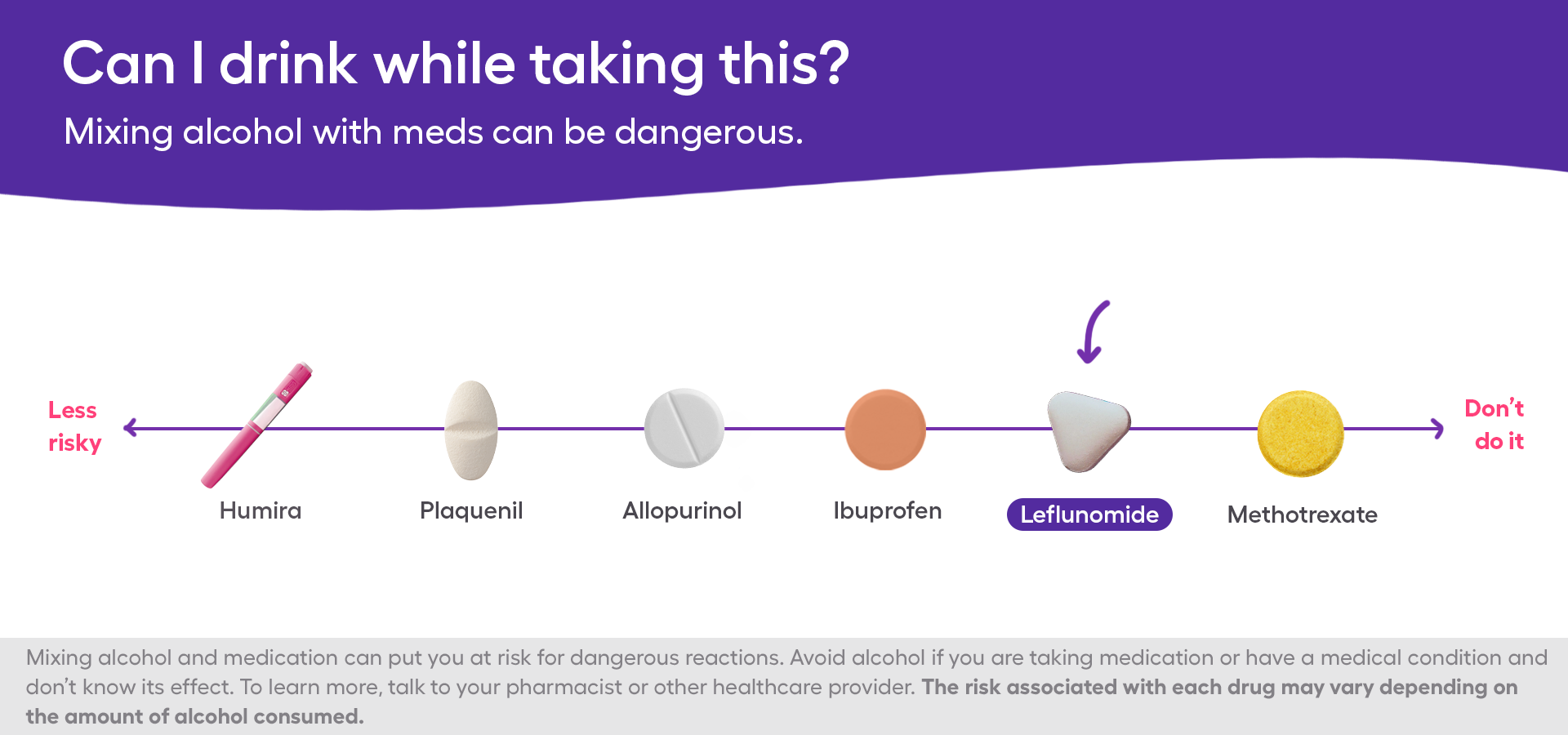
Nevertheless, certain arthritis drugs may be safer options if you are looking to have a glass of wine. For example, Plaquenil (hydroxychloroquine) and Humira (adalimumab) do not have any known interactions with alcohol.
However, several arthritis medications do interact with alcohol. These interactions can increase the risk of serious side effects, such as liver damage and gastrointestinal (GI) ulcers or irritation. And as discussed above, alcohol itself may increase the risk of or worsen symptoms of arthritis. Arthritis medications that can interact with alcohol include:
- Trexall (methotrexate): Drinking alcohol with Trexall can increase your risk of liver damage.
- Nonsteroidal anti-inflammatory drugs (NSAIDs), such as over-the-counter Advil (ibuprofen) and Aleve (naproxen): Mixing alcohol with NSAIDs can increase the risk of GI bleeding and ulcers.
- Tylenol (acetaminophen): According to the National Institute on Alcohol Abuse and Alcoholism, combining Tylenol and alcohol can cause severe liver damage, especially if you consume three or more alcoholic drinks per day.
Your healthcare provider can discuss which medications are best for you, especially if you regularly consume alcohol.
The bottom line
Due to the risk of serious liver damage, it’s typically not recommended to drink heavily while taking leflunomide, and some providers advise avoiding alcohol altogether. Nevertheless, some healthcare professionals may approve of light alcohol consumption if you don’t have pre-existing liver problems or take other hepatotoxic drugs. If you drink while taking leflunomide, your healthcare provider may monitor your liver function tests to ensure your liver stays healthy. Always seek medical advice from your healthcare team before mixing leflunomide and alcohol.
- About moderate alcohol use, U.S. Centers for Disease Control and Prevention (2025)
- Alcohol-associated liver disease, Johns Hopkins Medicine
- Alcohol-mediation interactions: potentially dangerous mixes, National Institute on Alcohol Abuse and Alcoholism
- Alcohol’s effects on health, National Institute on Alcohol Abuse and Alcoholism (2025)
- Alcohol and arthritis, Arthritis Foundation
- Elimination half-life of drugs, StatPearls (2025)
- Excessive alcohol consumption and the risk of knee osteoarthritis: a prospective study from the Osteoarthritis Initiative, Osteoarthritis and Cartilage (2022)
- Leflunomide, Medline Plus (2024)
- Leflunomide (Arava), American College of Rheumatology (2025)
- Leflunomide tablets prescribing information, DailyMed (2024)
- Liver disease, MayoClinic
- Liver disease, National Institute of Diabetes and Digestive and Kidney Diseases
- Leflunomide, StatPearls (2023)
- Liver function declines with increased age, HPB (Oxford) (2016)
- Long term alcohol intake and risk of rheumatoid arthritis in women: A population based cohort study, The BMJ (2012)
- Quantifying the hepatotoxic risk of alcohol consumption in patients with rheumatoid arthritis taking methotrexate, Annals of the Rheumatic Diseases (2017)
- The role of alcohol consumption in pathogenesis of gout, Critical Reviews in Food Science and Nutrition (2022)
- What is adalimumab? Versus Arthritis
- What is hydroxychloroquine? Versus Arthritis
- What is leflunomide? Versus Arthritis
- Medically accurate: SingleCare’s Medical Review Board analyzes all of our content to confirm it’s in line with current medical advice.
- Evidence-based: Our content is sourced from reputable U.S.-based healthcare professionals and peer-reviewed research.
- Trustworthy: All of SingleCare’s content goes through a multi-phase review process by our writers, editors, and Medical Board in order to provide clear and credible information.