What causes erectile dysfunction? Diagnosis, prevention, and treatment


Overview: What is erectile dysfunction?
Erectile dysfunction (ED) occurs when men either do not have sufficiently rigid erections or cannot maintain erections long enough to have satisfactory sexual experiences. Though more common in older men, young men can also have erectile dysfunction. Although ED is not health-threatening, it can be emotionally distressing for the man and his partner and reduce the overall quality of life. ED may be a precursor to more severe health problems such as coronary artery disease. For this reason, men with ED should talk to a healthcare professional.
Key takeaways:
Erectile dysfunction is a common health condition that primarily affects men older than the age of 40. Find updated erectile dysfunction statistics here.
Psychological problems, lifestyle habits, some medical conditions, or medications can cause erectile dysfunction. Most cases of ED have multiple causes.
Risk factors for erectile dysfunction include aging, high blood pressure, high cholesterol, low testosterone, depression, smoking, a sedentary lifestyle, and excess weight.
Symptoms of erectile dysfunction include insufficiently rigid or enduring erections.
Erectile dysfunction usually requires a medical diagnosis.
Erectile dysfunction generally does require treatment. It typically resolves to some degree with treatment within variable time frames depending on the causes responsible.
Treatment of erectile dysfunction may include lifestyle changes, psychological and relationship counseling, prescription medications, vacuum pumps, implants, surgery, and treatment of any underlying medical conditions. Read more about erectile dysfunction treatments here.
Erectile dysfunction may be preventable by lifestyle changes.
Use coupons for Cialis (tadalafil), Viagra (sildenafil), and Muse (alprostadil) to save up to 80%.
What causes erectile dysfunction?
Erectile dysfunction has many causes. Most cases involve more than one. These causes may be psychological, lifestyle-related, physical, or due to medication side effects.
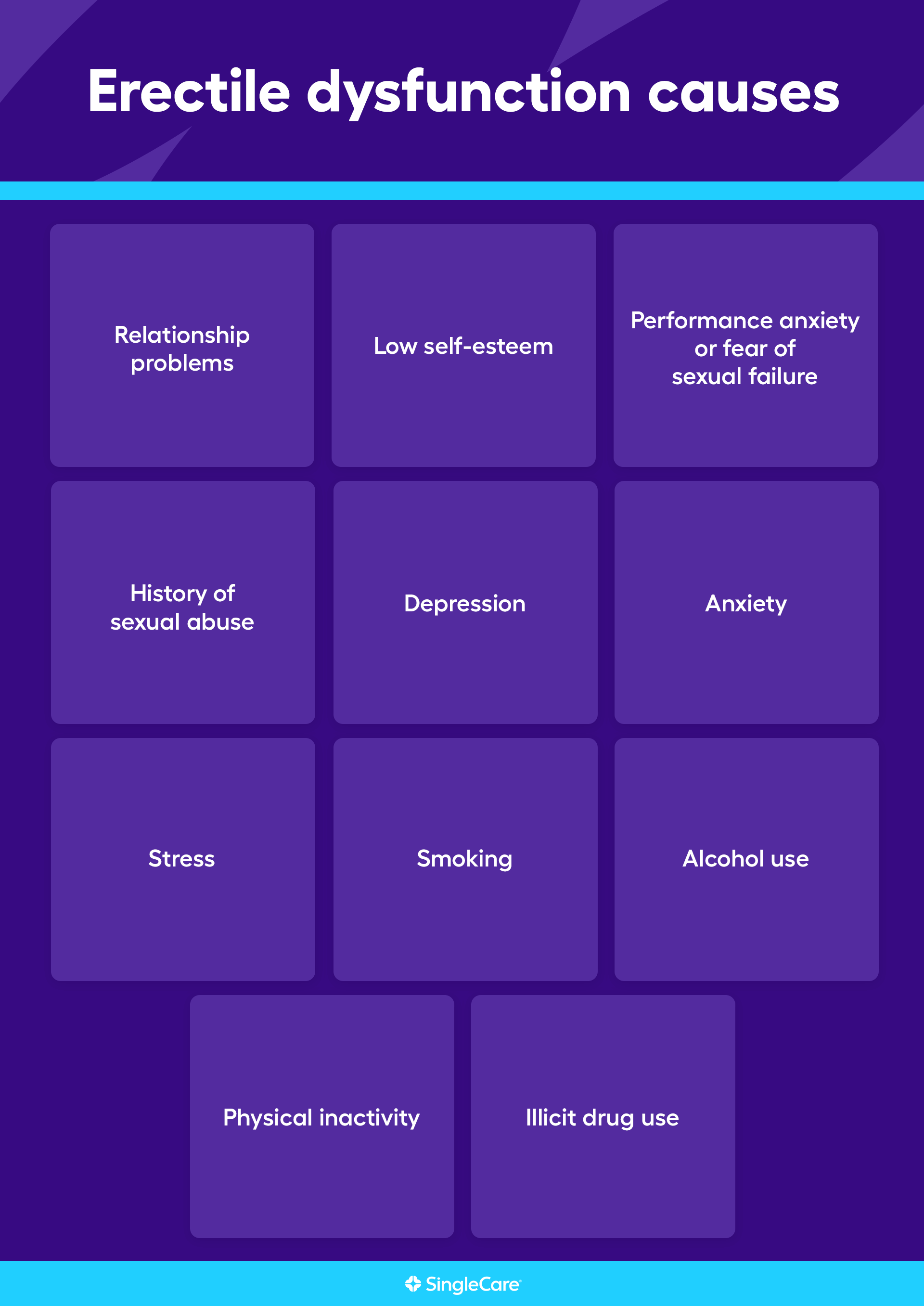
One study concluded that psychological issues cause up to 40% of erectile dysfunction problems. Keep in mind that physical causes are usually also involved. Psychological problems that cause ED can be general, like depression, or specific, like relationship problems. The most common psychological causes of ED include:
Relationship problems
Low self-esteem
Performance anxiety or fear of sexual failure
History of sexual abuse
Stress
Lifestyle habits also cause or contribute to ED, mainly:
Smoking
Alcohol use
Physical inactivity
Illicit drug use
Some medical conditions can cause or contribute to erectile dysfunction. These include:
Cardiovascular disease
Atherosclerosis
Hormone imbalances such as thyroid problems or low levels of testosterone
Nervous system problems such as multiple sclerosis, Parkinson’s disease, or stroke
Obesity
Prostate cancer treatment (such as radiation treatment or surgery)
Injury (like spinal cord injury)
Some people with ED may have a physical problem with their penis, such as:
Peyronie’s disease (scarring and deformity of the penis)
Injury to the penis
Genital pain
Nerve damage
Inability of the veins to retain blood in the penis
Complications of priapism (a painful, prolonged erection that can be damaging)
Erectile dysfunction is a side effect of some medications including:
Blood pressure medications
Tranquilizers
Some heart drugs
Hormones and hormone medicines
Parkinson’s drugs
Some cancer drugs
Risk factors for erectile dysfunction
The most significant risk factor is age. ED primarily affects men older than 40.
Other than age, the most significant risk factors include:
Hypertension
High cholesterol
Metabolic syndrome
Low testosterone
Smoking
Alcohol abuse
Physical inactivity
Obesity
Diets low in whole-grain foods, vegetables, and fruits
Diets high in red meat, dairy products, and sugar
Is erectile dysfunction serious? When to see a doctor
Erectile dysfunction is not a serious health threat, but it can decrease a man’s quality of life and sex life. It can cause distress, depression, anxiety, and relationship problems. However, ED can also be an early sign of a more serious problem: atherosclerosis, the buildup of cholesterol and fatty plaques in the arteries. The penis may be one of the first symptomatic sites of atherosclerosis because its arteries are small. At more advanced stages, atherosclerosis can block the blood flow in the larger arteries feeding the heart, a condition called coronary artery disease. This increases the risk of heart disease, chest pain, and heart attack. ED often occurs two to five years before coronary artery disease. Because of this association, men should see a primary care doctor about ED just in case.
RELATED: How to find an erectile dysfunction doctor and what to expect
How is erectile dysfunction diagnosed?
A diagnosis starts with a medical history, sexual history, and physical examination. The healthcare provider will need to know about medications and supplements, relationship issues with your partner, and lifestyle habits such as smoking or drinking. Some doctors may request to talk to both you and your partner at the same time.
Questions about history of sexual health will be very personal, so expect to answer questions like:
When did the problem start?
Did the problem start gradually over time or all at once?
What changed in your life?
Is the erection problem about getting hard, staying hard, or both?
How hard are your erections on a 0 to 100 scale, with 50 just enough for penetration?
How long do erections typically last?
At what point during sexual intercourse does your penis lose its rigidity?
Are erections better with your partner or other partners?
Are erections better when you masturbate?
Are there problems with orgasms or premature ejaculation during sexual activity?
Do you have spontaneous erections in the morning? At night?
Does the rigidity of your erections vary throughout the day?
Has your sexual desire changed?
How often do you want to have sex? How often does your partner want to have sex?
In a physical examination, the doctor will look for signs of blood vessel problems, heart problems, and low testosterone. If the doctor suspects a heart problem, a full cardiovascular examination may be needed. In many cases, the doctor may send people to see a mental health professional for evaluation.
Blood tests cannot test for ED, but they’re useful for figuring out if there’s an underlying problem such as diabetes, high cholesterol, low testosterone, thyroid problems, or sickle cells. There are specialized tests that can be performed on the penis, but they are usually used only in certain cases.
RELATED: Diagnosing erectile dysfunction: tests & next steps
Is erectile dysfunction hereditary?
Heredity may have some role in erectile dysfunction, but it may not be that relevant. A twenty-year-old study on twins determined that the influence of genetics on ED is about 29%-36%. A recent study found a single genetic mutation that may be predictive of erectile dysfunction. However, any particular case of erectile dysfunction has several causes contributing to the problem. No two cases are necessarily alike. For this reason, healthcare professionals don’t consider genetics to be a critical factor in diagnosing or treating ED.
Is erectile dysfunction curable?
Erectile dysfunction is treatable, but the level of improvement will vary depending on the underlying causes and the person’s commitment to treatment. Because many different factors typically cause dysfunction, treatment will vary by patient. Treatment options include:
Lifestyle changes such as weight loss, smoking cessation, dietary changes, exercise, and so on
Treatment of the underlying causes
Psychological, sexual, or relationship therapy
Prescription PDE5 inhibitors such as Cialis (tadalafil), Viagra (sildenafil), Levitra (vardenafil), and Stendra (avanafil)
Prostaglandin pellets or injections
Vacuum pumps
Penile implants
Vascular surgery on the penis
Treatment usually improves erectile dysfunction, sometimes dramatically. However, for some men, erectile function may not fully return. The healthcare provider and the patient will need to discuss acceptable treatment goals.
RELATED: Erectile dysfunction treatments and medications
How to prevent erectile dysfunction
Most healthcare professionals believe lifestyle changes have a prominent role in preventing and treating erectile dysfunction to improve sexual performance. Some think lifestyle is more fundamental to the problem. The European Association of Urology advises doctors that lifestyle changes should precede any medical treatment.
A few things have been shown by research to improve or prevent ED:
Weight loss—one study found that men who are obese are 50% more likely to have erectile dysfunction than men of average weight.
Smoking cessation
Reducing alcohol intake
A diet high in whole-grain foods, legumes, vegetables, and fruits
A diet low in red meat, whole-fat dairy products, and sugary foods
Stress management
RELATED: 12 foods that help ED—and 3 to avoid
Most importantly, see a doctor if erectile dysfunction is moderate or severe
There are many causes of erectile dysfunction. Some may be due to relationship or mood issues. Some may be physical. It’s complex. However, erectile dysfunction may be due to blood vessel problems. This is as true for younger men as it is for older men. ED may be an early sign of atherosclerosis and a precursor to coronary artery disease, heart disease, and heart attack. If erection performance has declined notably, see a doctor just for good measure. Even if atherosclerosis is not a problem, the doctor may discover a previously unknown health problem like Type 2 diabetes or high blood pressure.
FAQs about erectile dysfunction causes
What causes erectile dysfunction in older males?
Erectile dysfunction primarily is a men’s health issue occurring in men older than 40. It can be caused by relationship issues, psychological problems, lifestyle habits, medical conditions, and drugs. Some causes, like medication side effects, may be easy to fix. Other causes, like relationship issues, may be more difficult and time-consuming to fix.
What causes erectile dysfunction in young males?
About one in 10 men younger than the age of 40 have erectile dysfunction at some point. As with older men, situational, psychological, or physical causes may be the culprit of their sexual functioning. In younger men, the cause is more likely to be due to a health problem. Most importantly, erectile dysfunction in younger men can be a sign of potentially more serious vascular issues.
What causes sudden erectile dysfunction?
A rapid onset of erectile dysfunction is usually a sign that the problem is psychological. Other symptoms of psychogenic ED are normal spontaneous erections (such as nighttime or morning erections), variability of erectile rigidity, and inability to maintain an erection. Men with psychogenic erectile dysfunction usually respond extremely well to a PDE-5 inhibitor like Viagra (sildenafil).
What’s next? Additional resources for people with erectile dysfunction
Test and diagnostics
Diagnosing erectile dysfunction: tests & next steps, SingleCare
Erectile dysfunction, American Family Physician
Erectile dysfunction, StatPearls
Treatments
Erectile dysfunction, American Family Physician
Erectile dysfunction, Nature Reviews Disease Primers
Erectile dysfunction, StatPearls
Erectile dysfunction treatments and medications, SingleCare
Guide to erectile dysfunction pills, drugs, & medications, SingleCare
Scientific studies and clinical trials
Abdominal obesity and physical inactivity are associated with erectile dysfunction independent of body mass index, The Journal of Sexual Medicine
A population-based, longitudinal study of erectile dysfunction and future coronary artery disease, Mayo Clinic Proceedings
Comprehensive intersystemic assessment approach to relieve psychogenic erectile dysfunction: a review, Open Access Macedonian Journal of Medical Sciences
Genetic risk factor associated with erectile dysfunction, National Institute of Diabetes and Digestive and Kidney Diseases (NIDDK)
More information on related health conditions
Can stress and anxiety cause ED?, SingleCare
Subscribe to our savings newsletter
Health education, drug info, wellness & more
By clicking 'Subscribe', I agree to SingleCare's Terms & Conditions.








