




 Search for articles or Rx savings



Key takeaways
There is no official warning against combining alcohol with ciprofloxacin.
Drinking while taking ciprofloxacin may worsen side effects such as nausea and drowsiness, and it may impede your body’s natural healing process.
People with liver problems, gastrointestinal issues, or older age might be more affected by alcohol while on ciprofloxacin.


Ciprofloxacin is a quinolone antibiotic sold under the brand name Cipro. This generic antibiotic is available as a liquid solution, oral tablet, or intravenous solution and is FDA approved to treat a wide range of bacterial infections, from urinary tract infections (UTIs) and infectious diarrhea to pneumonia and intra-abdominal infections. While mixing alcohol and ciprofloxacin isn’t always recommended, most healthcare providers say it’s unlikely to cause problems if you drink in moderation.
Save up to 80% on Ciprofloxacin with SingleCare
Different pharmacies offer different prices for the same medication. SingleCare helps find the best price for you.


Can you drink while taking ciprofloxacin?
Alcohol does not directly interact with ciprofloxacin, so some people may be able to drink in moderation while taking it. The Centers for Disease Control and Prevention (CDC) defines moderate alcohol use as one drink per day for women and two drinks per day for men.
Consult your prescriber before drinking while on ciprofloxacin, as recommendations can vary by individual, especially for people with a history of alcohol misuse or liver problems. Ciprofloxacin has been linked to rare cases of acute liver injury. More commonly, “liver enzyme bumps can happen, but are usually temporary,” says Allie Buttarazzi, MD, a double board-certified physician and co-owner of Maine Street Medical near Portland, Maine.
What happens if you mix ciprofloxacin and alcohol?
Mixing ciprofloxacin and alcohol doesn’t cause issues for everyone, especially if alcohol consumption is limited to an occasional drink or two. However, just because combining alcohol with an antibiotic is unlikely to cause harm, it does not mean it is recommended.
Combining ciprofloxacin with alcohol has the potential to cause three specific issues: changes to the way your body metabolizes the drug, an increased risk of side effects, and impaired healing of the underlying infection.
Altered metabolism
“Alcohol can change how quickly your body processes a medication. If it speeds up processing, the antibiotic may not work as well. If it slows it down, the drug can build up, raising the risk of side effects or even toxicity,” Dr. Buttarazzi says.
Increased risk of side effects
Some of the effects of ciprofloxacin and drinking alcohol are similar. Given that, mixing the two can increase the potential of experiencing unpleasant side effects.
For instance, possible side effects of ciprofloxacin include:
- Stomach problems like nausea, vomiting, abdominal pain, indigestion, and diarrhea
- Extreme, unusual tiredness
- Sleepiness
Combining Cipro and alcohol might not be unsafe, but the compounded nausea might be unpleasant, and the doubled risk of drowsiness can lead to impaired judgment and potentially dangerous situations, especially when driving or operating machinery.
Impaired healing process
Alcohol consumption may undermine the reason someone is on ciprofloxacin in the first place: Healing an infection. Chronic heavy drinking has been linked to poorer immune system function. Alcohol can also negatively affect sleep health. If someone has an infection, the best course of action is to support the healing process with healthy lifestyle choices like eating nutrient-dense foods, getting enough sleep, and limiting unhealthy substances such as alcohol and tobacco.
Are certain people at greater risk of side effects?
Absolutely. Some people are more likely to experience side effects when taking ciprofloxacin, and drinking alcohol could exacerbate these issues. Dr. Buttarazzi says older adults and people with chronic kidney disease process drugs more slowly, so side effects are more likely.
Other people with a greater risk of serious ciprofloxacin side effects include those with existing tendon problems, peripheral neuropathy, seizure disorders, central nervous system (CNS) disorders, and myasthenia gravis, according to Jennifer L. Armendariz, AOCNP, a family nurse practitioner and hematology/oncology specialist in El Paso, Texas. All of these conditions can increase the risk of side effects from ciprofloxacin.
Though alcohol doesn’t interact with ciprofloxacin, other substances do. It’s important to be aware of this antibiotic’s potentially harmful interactions with the following drugs and other substances:
- Cymbalta (duloxetine)
- Zanaflex (tizanidine)
- Warfarin
- Certain antidepressants
- Certain dairy products (due to calcium interaction)
- Calcium- or magnesium-containing multivitamins, antacids, or supplements
People who regularly take or eat the above substances should seek medical advice on how to avoid negative drug interactions. Finally, since ciprofloxacin presents a rare risk of liver damage, anyone with liver issues—or who takes another medication that can also cause liver damage—has a higher risk of complications when mixing this antibiotic with alcohol.
How long after taking ciprofloxacin can you drink alcohol?
There is no recommended waiting period between taking ciprofloxacin and alcohol consumption. Many people can drink in moderation while taking this antibiotic. However, anyone experiencing stomach problems from ciprofloxacin should avoid drinking alcohol shortly after taking their medication since alcohol can exacerbate nausea and vomiting.
The half-life of ciprofloxacin is four hours, which means that half the active and circulating drug concentration has been eliminated from the body at that time. It takes several half-lives for a drug to be fully cleared from the system, so some ciprofloxacin will stay in your body until the next dose.
Which antibiotics are not affected by alcohol?
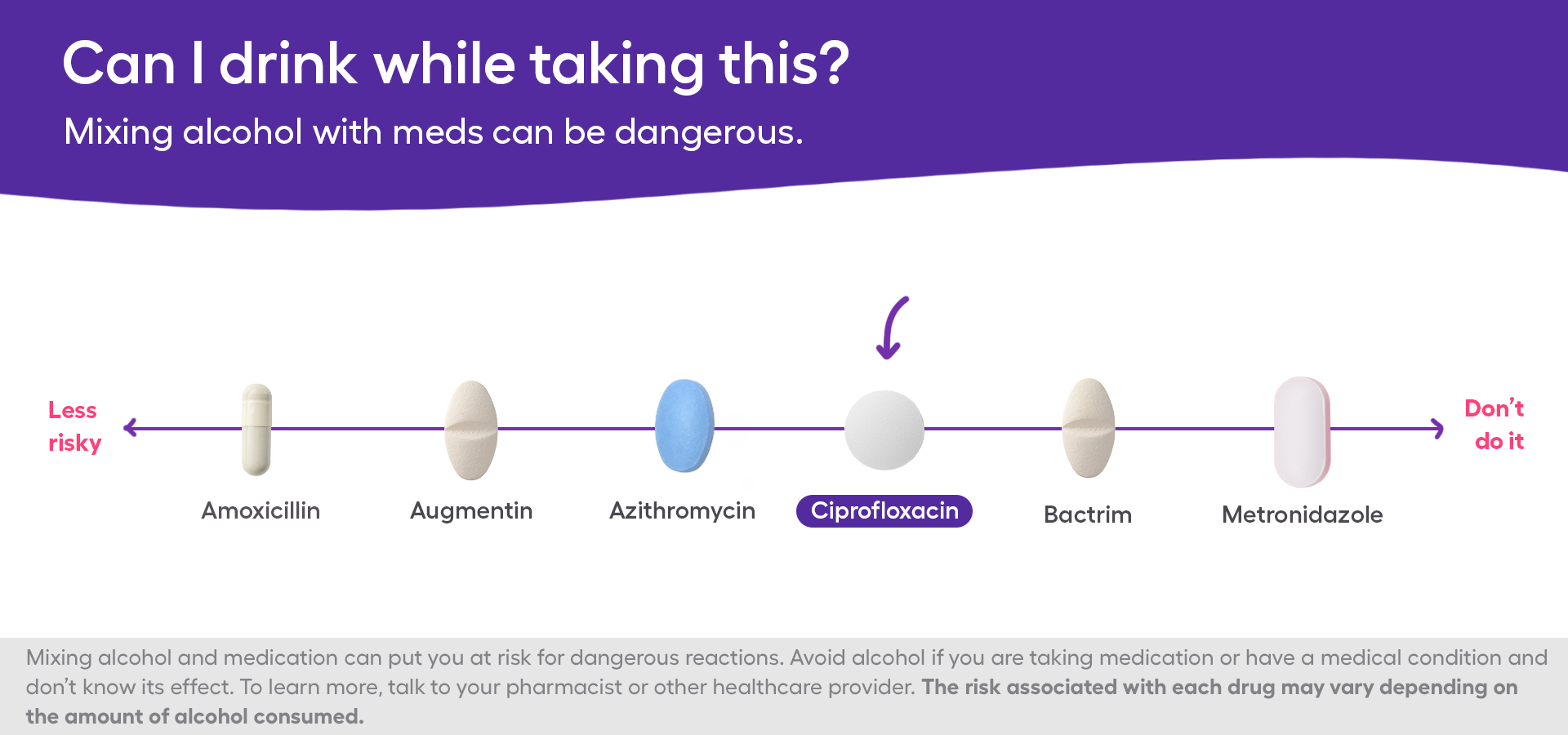
“It seems to be a common thought that antibiotics and alcohol will react poorly. However, the evidence of this is quite poor,” Armendariz says. “It is true that with certain antibiotics, alcohol does need to be avoided, but not all.” According to Dr. Buttarazzi, most antibiotics, including Augmentin, amoxicillin, cefdinir, cephalexin, azithromycin, and nitrofurantoin, are not significantly affected by light or moderate alcohol consumption. Again, that’s one drink per day for women and two drinks per day for men.
Though many antibiotics are not affected by alcohol, some have significant interactions.“Some, like metronidazole, can cause intense nausea, vomiting, and rapid heart rate with even a single drink,” Dr Buttarazzi says.
The following antibiotics should not be mixed with alcohol due to a heightened risk of complications such as high blood pressure and liver damage:
There are several antibiotic treatment options not directly affected by alcohol, but it’s better to be safe than sorry. Always check with a healthcare professional before mixing an antibiotic with alcohol, and always seek medical help for serious side effects or signs of an allergic reaction.
The bottom line
Many people can safely drink in moderation while taking ciprofloxacin. That’s because alcohol does not have a direct impact on the safety or effectiveness of this antibiotic. However, ciprofloxacin may cause nausea, vomiting, and fatigue — all potential side effects that could be exacerbated by alcohol. People with a history of alcohol misuse, liver issues, gastrointestinal issues, or older age have the most significant risk of discomfort or complications from mixing ciprofloxacin and alcohol.
Recommendations for alcohol consumption on prescription drugs may depend on your medical history and other medications, including over-the-counter medicines. “Always check with your healthcare provider,” Armendariz says.
- Fact versus fiction: A review of the evidence behind alcohol and antibiotic interactions, Antimicrobial Agents and Chemotherapy (2020)
- Flagyl (metronidazole oral formulation), Pfizer (2025)
- About moderate alcohol use, Centers for Disease Control and Prevention (2025)
- Impact of alcohol abuse on the adaptive immune system, Alcohol Research (2015)
- Alcohol and sleep, Sleep Foundation (2025)
- Ciprofloxacin, LiverTox: Clinical and Research Information on Drug-Induced Liver Injury (2012)
- CIPROFLOXACIN- ciprofloxacin tablet, film coated, U.S. Food and Drug Administration (2025)